

Egyptian pyramids, Giza
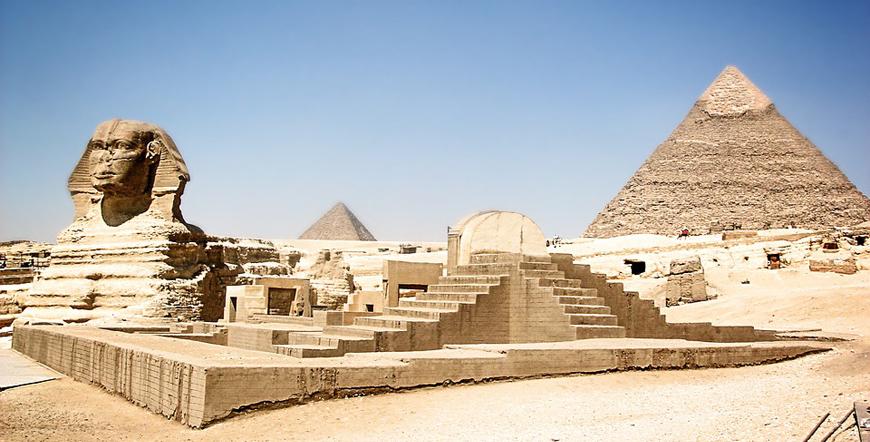
The Egyptian pyramids are the only surviving of the Seven Wonders of the Ancient World, and in this sense they sometimes include the Sphinx of Giza.
Perhaps Giza was a huge construction site, as three massive stone monuments tower today over the desert near Giza, not far from the modern Egyptian capital Cairo. Its population was dominated by architects, masons, surveyors and workers who worked with sweat on their foreheads under the scorching rays of the sun. The largest of the Egyptian pyramids is the Great Pyramid, located between the Nile and the Western Desert and built for more than 20 years. It was completed around 2560 BC and in it is the burial chamber of Khufu (Cheops) - an Egyptian pharaoh who died approximately in 2566 BC. Even today, standing before its majesty, visitors to the Great Pyramid are overwhelmed with awe. A relative of Khufu, Hemon, is considered the chief architect and overseer.
In general, the Egyptian pyramids are located on the west bank of the Nile, in the Memphis necropolis. The ancient Egyptians believed that this was the land of death, because the sun sets in the west. Their homes rose on the east bank of the river. After the death of Khufu (Cheops), his body was transported in a boat on the Nile to the temples in Giza, and later - sealed in one of the three burial chambers inside the great pyramid.
The ancient Egyptians believed that the survival of the world depended on the successful passage of the pharaoh to the afterlife - in fact, the pyramid was a huge launching pad, where the spirit of the late ruler began his afterlife. Indeed, Khufu has attained a certain kind of immortality because the tomb immortalizes his name.
For thousands of years, the Great Pyramid has remained the largest and most famous building in the world. The Great Pyramid was surrounded by temples and smaller pyramids, and later two more giant tombs were added to the temple complex - the pyramids of Khafra (Khafre) and Mankaura (Mycerinus).
Some of the pyramids do not withstand the destructive power and destructive effects of time, while others have sunk into the sea of desert sand. The most ancient version of the Egyptian pyramids is considered to be the "stepped pyramid" like the one near Saqqara, which Pharaoh Djoser ordered to be built.
There are many stepped pyramids, most unfinished, but there is another unusual pyramid near Dashur. Its walls form a bend and it looks as if its builders intended to raise it much higher, but, having just completed the lower third, decided to shorten the deadline for its completion to ten years. Here the variety of the Egyptian pyramids is exhausted, and those that belong to the wonders of the world are regular four-sided pyramids with a square base and look like two drops of water.
Vote:
Rating 1 from 1 voted


