

Luxor Temple, Egypt
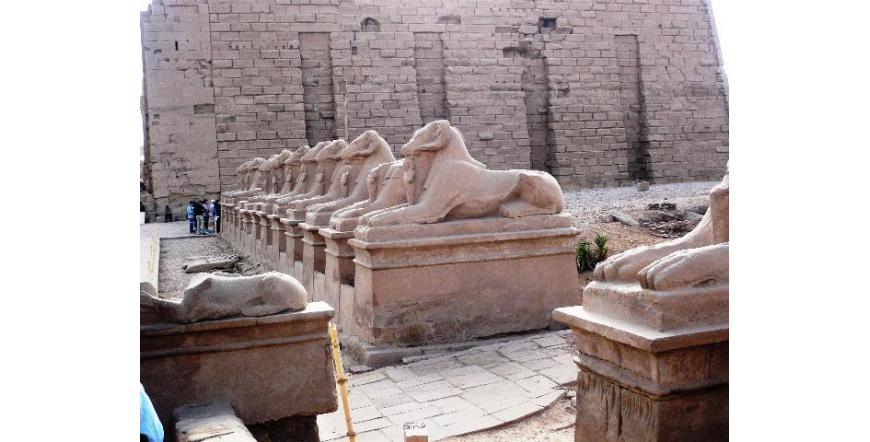
Three gods - Amun, Mut and Honsu, are worshiped in the Luxor Temple. This is a large ancient Egyptian temple complex located on the east bank of the Nile, in a city today known as Luxor, but in ancient times known as Thebes.
Luxor Temple is revered as the strongest embodiment of the architectural features of the New Kingdom (XVI-XI century BC). It is distinguished by a grandiose design, monumentality and a large number of columns.
The temple of Luxor brings timelessness, it is rich in reliefs and tranquility. The greatest pleasure from visiting the temple is obtained in the evening, when the lighting gives more magnetism to the atmosphere hovering between its walls.
From ancient times the temple has always been in the center of the territory on which it was built. Its construction is due to Amenhotep III, who marked the zenith of ancient Egyptian power and influence. The Luxor Temple owes its good condition because it was made of sand and because the village of Luxor was built right around it.
The way of the sphinxes is the way to get to the temple of Luxor. Its characteristic feature are the sphinxes, which stop in front of the giant first pylon. It, as well as the temples later built in addition, are the work of another great ruler of Egypt - Ramses II.
He is depicted on it, as well as on six other giant statues - two in a sitting position and four in a standing position. Behind the pylon, it is the turn of the Great Court of Ramses II to be examined. It is one of the innovations, in one corner of which is the Abou al-Haggag Mosque.
It is interesting to visit Luxor during the holiday in honor of Abou al-Haggag, the so-called "Mold". Attention must be paid to the 40 columns forming the so-called. a colonnade of solemn processions, the most impressive part of the Luxor Temple - the Sun Courtyard, as well as its oldest part - the "holy of holies" the central sanctuary.
Vote:
Rating 3 from 9 voted


