

Lausanne, Switzerland
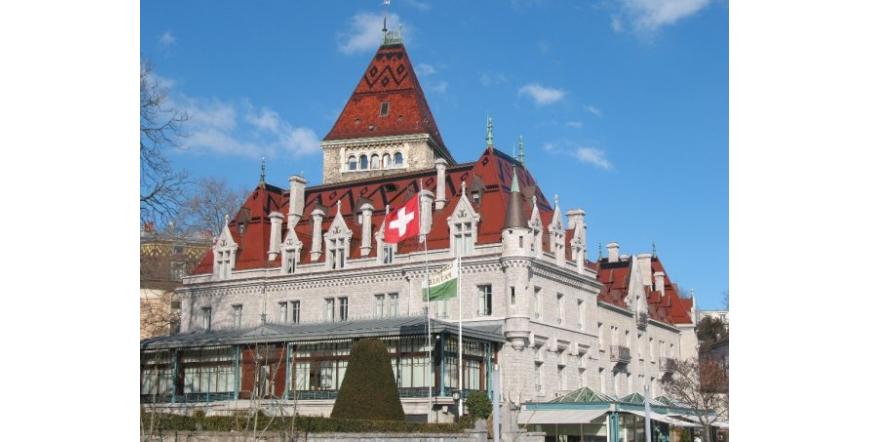
They call it the Swiss San Francisco - with steep hills on which balconies are perched, blue water and shining sun, with the jutting purple and grey peaks of the Savoy Alps. This is Lausanne, immersed in greenery and parks.
Lausanne is a city in western Switzerland, the main administrative centre of the canton of Vaud. Lausanne was founded as a Celtic settlement, later converted into a Roman military camp. Lausanne is located at 495 m above sea level in the central part of the canton of Vaud, on the northern shore of Lake Geneva, in the French-speaking part of Switzerland. In the centre of Lausanne, the covered streams of Leuve and Flonne converge, from the valleys of which 3 hills are formed in the centre: the Sith, Le Bourgh and St-Laurent.
Lausanne ranks second in importance in Switzerland after Geneva. Although Geneva is today considered the international centre of diplomacy, Lausanne also hosts a huge number of international conferences. An important example is the negotiations held in the city in 1923, which determined the borders of Turkey after the First World War. Lausanne is also an important railway junction on the Bern-Geneva line and there is a direct link to Paris. The city is the headquarters of the International Olympic Committee.
The history of Lausanne began to be written when the first settlements appeared in the fourth millennium BC - the first military camp built by the Romans, Lusana, dates back to 15 BC. Today, excavations of this camp can be seen near Lake Geneva.
Due to frequent German raids in the middle of the 4th century, Lausanne was abandoned and all the inhabitants moved to the hills above the lake. In the Middle Ages, the rule of Lausanne passed into the hands of bishops and dukes of Savoy. During the Reformation, the access of the Savoyards to the modern canton of Vaud was blocked by Geneva and the city came under the rule of the Dukes of Bern and remained so from 1536 until 1798. As a result of the Napoleonic Wars, in 1803 Lausanne became the capital of the newly created canton of Vaud, which joined the Swiss Confederation.
Lausanne is not just a city occupying a perfect geographical location. This city knows how to be welcoming, to entertain, to provide recreation.
Lausanne's main and best-known landmarks are the Town Hall, the Chateau de Beaulieu, the Gothic Church of St. St. Francis, Notre Dame Cathedral, Hermitage Park and Museum, Mont-Repot Park, Elysee Park, Fountain of Justice, Palais de la Rumine, Saint-Mer Castle, and the waterfalls of Trümmelbach and Staubach.
Apart from everything else it is famous for, Lausanne is a city with many museums - the Old Town, the Elysée Museum, the Lausanne Historical Museum, the Cantonal Museum of Archaeology and History, the Museum in the Château de Beaulieu with works by prisoners and mentally ill people, the Hermitage Foundation, the Cantonal Museum of Fine Arts, the Cantonal Museum of Archaeology and History, the Cantonal Museum of Geology, the Cabinet of Cantonal Medals, etc.
Lausanne possesses a part called the Old Town which is extremely enticing to explore. For the most part, the old part is off-limits to cars, and cute little streets with cafes and boutiques accompany the medieval look of the town. The old town stands out for its 12th-century Gothic cathedral. It is considered to be the most impressive early Gothic work of art in Switzerland and is listed among the ten most beautiful cathedrals in the world.
Vote:
Rating 5 from 1 voted
More sights in Switzerland


Weather in Lausanne, Switzerland

15.97 °C
Wind: 2.95 m/s
Humidity: 97 %
Pressure: 1011 hpa
Clouds: 100 %
Wind: 2.95 m/s
Humidity: 97 %
Pressure: 1011 hpa
Clouds: 100 %