

Bellinzona, Switzerland
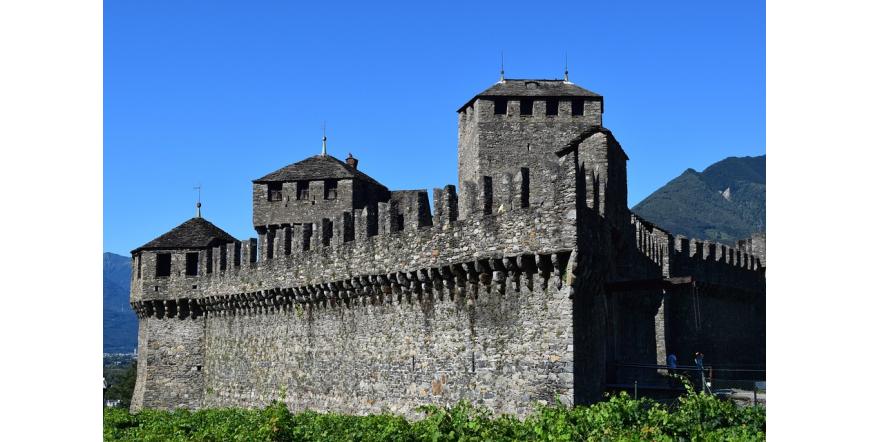
Bellinzona is a beautiful Swiss town, quite often passed by on the way to Lugano or Locarno. Walking around this charming little town is a real treat - pedestrian streets and squares, lots of good cafes and restaurants. Above this idyllic relaxed atmosphere of the town rise its guardians - the three castles, whose walls are a relic left over from the historical struggles for control of the town. Bellinzona is part of the canton of Ticino and is an important transport hub, with the town being the last stop for many of the railway and post bus lines through the mountains.
Bellinzona is a town with a strategic location - it is on the approach to the passes of Saint-Gotthard, Lucmagnier and San Bernard. One could even say that its location is vital. Thus, Bellinzona is becoming an important regional center.
For a long time the rule of the city was in the hands of the Dukes of Milan. In the 16th century, however, they ceded control of Bellinzona to the cantons of Nidwalden, Schwyz and Uri. Although politically allied, the representatives of each of these cantons were to have separate castles. So Sasso Corbaro fell to Nidwalden, Montebello to Schwyz, and Castelgrande to Uri.
The Piazza Nazzetto is the heart of Bellinzona and forms an attractive public square in front of the Town Hall. It is a grand building and features frescoes depicting historical scenes.
Another impressive square is the Piazza Collegiata, a more authentic square featuring elegant aristocratic buildings from the 18th century. Above it rises the church of St. Stephen" and "St. Peter", which architecturally intertwined Renaissance and Baroque elements.
Speaking of temples of faith, we must also mention the finest church in Bellinzona, Santa Maria delle Grazie. It is a 15th century building and is located about 5 minutes walk from the center. The Franciscan church of Santa Maria delle Grazie stands out for its wonderful frescoes painted over the partition between the nave and the choir area, and depicting the crucifixion of Christ and 15 scenes from his life.
San Biagio is also an interesting 13th-century church with 14th-century interior decoration. Opposite it is the building of the town's art gallery - in the Villa of the Cedars. Its collections are dotted with 19th and 20th century paintings.
Let's pay attention to the three symbols of the city - its castles. The oldest of them is Castelgrande, a fortress of Roman origin. In the castle there is a restaurant and a small archaeological museum, which are part of the renovation project of the palace.
Montebello is the next castle, with construction beginning in the late 13th century. True time from its battlements you can see Lake Maggiore. In the tower of this castle of Bellinzona is the Archaeological and Urban Museum, which houses drawings on stone, historical sketches and engravings, as well as a large collection of glass and ceramics and jewellery.
Sasso Corbaro is the third castle of Bellinzona. It has undergone a recent renovation. To reach it, visitors have to climb up a winding path to cross two working bridges. Sasso Corbaro was erected by the Sforza family, and in a very short period of time - in six months in 1479 the fortress became a reality. In the castle of Sasso Corbaro there is the Museum of Folk Art, which has a magnificent room with walnut paneling.
Vote:
Rating 5 from 1 voted
More sights in Switzerland


Weather in Bellinzona, Switzerland

20.17 °C
Wind: 1.79 m/s
Humidity: 92 %
Pressure: 1011 hpa
Clouds: 100 %
Wind: 1.79 m/s
Humidity: 92 %
Pressure: 1011 hpa
Clouds: 100 %