

Bern, Switzerland
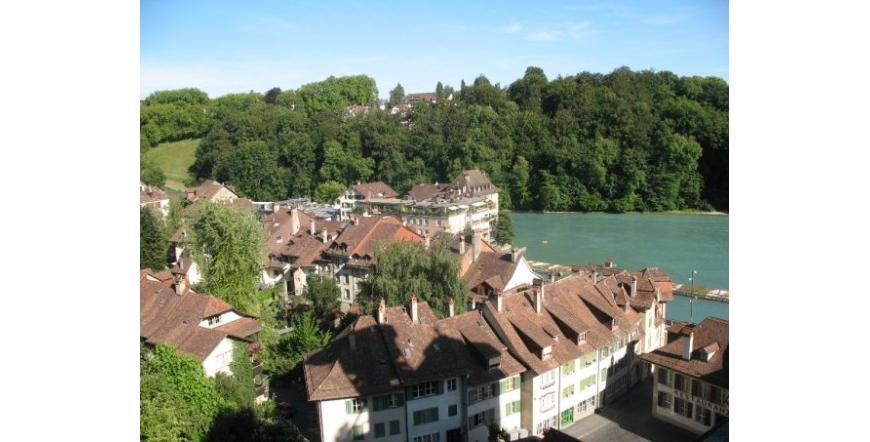
Located in the center of Switzerland, Bern is the "federal city" and de facto capital of Switzerland. The city of Bern is the seat of the Federal Council (government) and the Federal Assembly (bicameral parliament). Bern is also the capital of the Canton of Bern and the County of Bern. The city of Bern is located in the northwest of the country, on the Aar River, a left tributary of the Rhine. The city of Bern has excellent road and rail connections to every corner of the country. Bern is the only European capital reached by all three European high-speed train networks - the French TGV, the German ICE and the Italian Cisalpino.
The city of Bern is a remarkably small and modest city for the capital of a country. The city has preserved much of its urban center over the last few hundred years. The city of Bern extends in a 12 km radius around the old town in all directions. Despite its old-world air, the city is cosmopolitan and seethes with the opulence and excitement one would expect from a capital city. Switzerland's capital, Bern, has much more than one can see with one's eyes.
The city of Bern was founded as a settlement by Duke Berthold V von Zeringen on the River Aar in 1191 and named it after a bear, a ber, he had killed. The city of Bern became a free and independent city after the death of the Duke in 1218 and after receiving this privilege from the Holy Roman Emperor, Frederick II. Bern experienced its apogee in the late Middle Ages, and its influence extended as far east as Austria, south to Milan and west to the French-speaking region of Vaud. In 1353, Bern became the capital of the region. In 1353, the city of Bern became part of the young Swiss confederation and became the leading city. It annexed to its territories Arau in 1415 and Vaud in 1536, as well as other small territories. With these new lands, the city of Bern became the largest city-state north of the Alps. In 1831 the city became the capital of the canton of Bern, and in 1848 it became the administrative capital of Switzerland.
Legend tells how Bern got its name. The etymology of its name is still very controversial. The story goes that the founder of Bern, Duke Berthold V von Zeringen, before his first hunt in these lands, made a vow to name the town after the first animal he encountered. In this case, it turned out to be a bear and thus the name of the town was born.
The time of significant change for Bern came in the 19th century. As the city grew, most of the unnecessary fortifications were demolished and new public buildings sprang up all over the city, changing its appearance considerably. The city acquired new residential districts on the other side of the river. High bridges were built to connect them to the city center.
It would not be wrong to say that Bern is rich in attractions, many of which are concentrated in the Old Town, which in 1983 was listed as a World Heritage Site by UNESCO. The Old Town of Bern is distinguished and proud by the presence of numerous arcades - canopies running over the streets.
The Swiss government is one of the city's symbols and is housed in the palace-like Bundeshaus, a spacious 1902 building in Italian Renaissance style, with a distinctive feature - beautiful copper domes. The spacious Bundesplatz, on the other hand, is home to a glamorous dancing fountain with 26 jets of water that symbolise Switzerland's 26 cantons. Characteristically, the fountain is open from April to October and the jets appear unexpectedly between the tiles every half hour between 11:00 and 23:00. The grandeur of the Bundesplatz is enhanced by the beautiful buildings of the Old Town. One in particular is the 13th-century Züttgöturm clock tower, erected as part of the city's west gate and once used as a prison.
Another jewel of Bern is St. Vincent's Cathedral, located not far from the clock tower. Other must-visit places are the tourist attraction Bear Park, the Rose Garden and the city's artisans and workshops quarter, Matenquartier.
Must-see points of a Bern sightseeing tour are the Church of St. Spirit, the Whistler's Fountain, the Anna Seiler Fountain, the Musketeer's Fountain, the Child Eater's Fountain, the Zähringer Fountain, Einstein's House, Samson's Fountain, the Fountain of Justice and the Moses Fountain.
In addition to landmarks, official and ancient buildings, Bern is a city where carnivals and cultural events also abound. Here are some of them - the Bern Carnival, attracting thousands of visitors every year, the Bern International Jazz Festival, held since 1976, from March 13 to May 22, the Bern Grand Prix, a car race held annually and called by the organizers "the 10 most beautiful miles in the world", the Bern Women's Race, a carnival also known as "Frauenlauf" and held for the first time in 1987, The Street Festival, a music festival held in Bern's Old Town since 2004.
Vote:
Rating 5 from 1 voted
More sights in Switzerland


Weather in Bern, Switzerland

17.03 °C
Wind: 3.09 m/s
Humidity: 67 %
Pressure: 1010 hpa
Clouds: 75 %
Wind: 3.09 m/s
Humidity: 67 %
Pressure: 1010 hpa
Clouds: 75 %