

Sankt Gallen, Switzerland
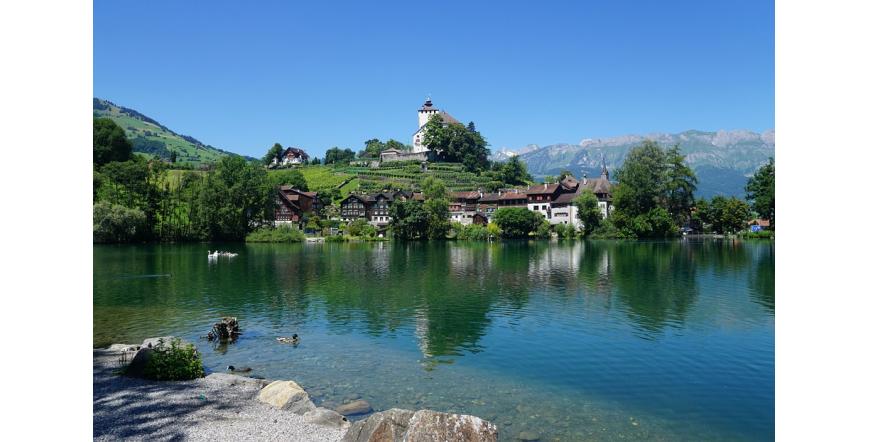
Sankt Gallen is a resort town in northeastern Switzerland, known for its textile industry and its monastic area. The main administrative center of the canton of Sankt Gallen, the town is situated around the river Sitter about 30 km west of the German border, in the German-speaking part of Switzerland, perched on either side of the river Steinach, flowing a short distance into Lake Constance. With its Abbey Library and Cathedral, Sankt Gallen was one of the most important religious and cultural centers in medieval Europe.
The first records of the Sankt Gallen as a settlement date back to 720. The monastery, which became the reason for the founding of the city, has no longer been active since the 19th century. The complex houses the library, a UNESCO World Heritage Site. It is one of the oldest and largest in Europe with over 2 thousand manuscripts, 1600 books from the beginning of printing and 160 thousand other volumes. During the Middle Ages, St. Gallen developed as a commercial and industrial center because it had all the prerequisites that are still valid today to attract people and investment. The roads paved for pilgrims stimulated trade, the monastery hospital and its own judge helped to shape the public sector, and the educated graduates of the monastic college helped to shape the human potential. After becoming a center of textile manufactures, industry and commerce, Sankt Gallen accumulated a lot of financial resources, which in turn became a prerequisite for the birth of the first banks.
Although Sankt Gallen is the economic and cultural center of Eastern Switzerland, the city is small and has only 75,000 inhabitants. The city is presented as a cozy center of enlightenment and culture, as well as the headquarters of some of the largest Swiss banks plus dozens of small private ones, hiding the billions of thousands of Americans and Europeans. Sankt Gallen is a city steeped in history and exquisite architecture, best seen in the Old Town. Various architectural, historical, and religious sites can be viewed and visited there, such as the Baroque Stiftskirche and Benedictine Abbey, among various other church and administrative buildings. The Stiftskirche is located on the route of pilgrims going to Santiago de Compostela in Spain, it was built in the 18th century and is a baroque cathedral with two twin towers.
The Abbey Library is the greatest landmark of the monastic complex and is a grand Baroque library of the "scripture of Europe", the main medieval cultural center. Other interesting sites in Sankt Gallen are the Greek Orthodox Church of St. Constantine and Helena, the University, the City Bath (the oldest in the country) and others.
As an important center of the textile industry, renowned especially for high quality embroidery and lace, it is only natural that the city should have a Museum of Textiles, a fascinating museum which displays some of the earliest mechanical looms and hand embroidery machines, fine examples of Sankt Gallen lace, a copy of a Michelle Obama dress embroidered in Sankt Gallen, and a very good selection of the latest fabrics. Other interesting museums are the Historical and Ethnographic Museum and the Natural History Museum. Also of interest is the Wegelin Bank, which is the oldest private bank in Switzerland. Another unique place in Sankt Gallen is a must-visit - the "world's largest open-air living room". This place is located in the Bleichele district and is a space in which a red carpet spreads over streets, benches, sofas and everything is designed by the multimedia artist Pipilotti Rist.
Vote:
Rating 5 from 1 voted
More sights in Switzerland


Weather in Sankt Gallen, Switzerland

16.46 °C
Wind: 6.17 m/s
Humidity: 88 %
Pressure: 1008 hpa
Clouds: 75 %
Wind: 6.17 m/s
Humidity: 88 %
Pressure: 1008 hpa
Clouds: 75 %