

Trabzon
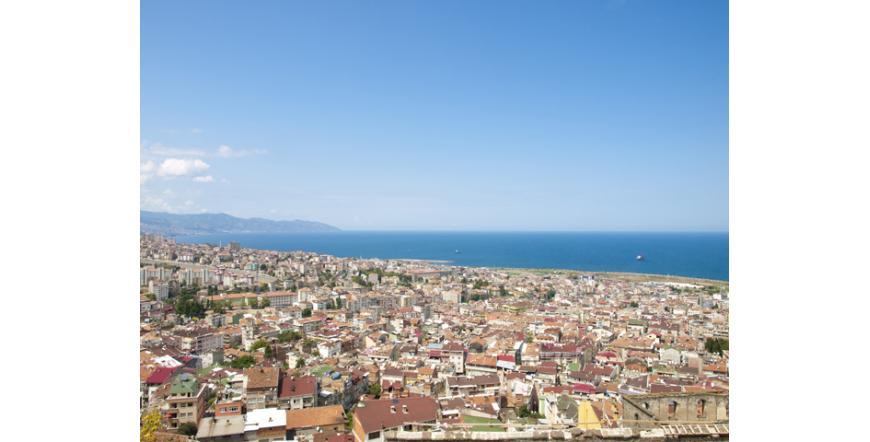
Trabzon is a town on the Black Sea coast of northeastern Turkey and the capital of the province of Trabzon. Trabzon, located on the historic Silk Road, has become over the centuries a trading portal for Persia in the southeast and the Caucasus in the northeast. Venetian and Genoese merchants visited Trabzon in the Middle Ages and sold silk, linen and woolen fabrics. The Republic of Genoa had an important trading colony within the city called Leoncastrone. Trabzon was the basis of several countries in its long history and was the capital of the Empire in Trabzon between 1204 and 1461. In the early modern period, Trabzon, due to the importance of its port, again became a center of trade with Persia and the Caucasus.
According to Greek sources, the city of Trabzon was founded in 756 BC. by Milesian merchants from Sinope. It was one of several Milesian trading colonies on the shores of the Black Sea. Like most Greek colonies, the city was a small enclave, not an empire. As a colony, Trapezos initially paid homage to Sinope, but it is believed that early banking appeared in the city as early as the 4th century BC, as evidenced by a silver coin - a drachma, from Trapez, located in the British Museum. in London. Cyrus the Great added the city to the Achaemenid Empire and was probably the first ruler to consolidate the eastern Black Sea region into a satrapy.
Until its conquest by Alexander the Great, Trabzon remained under the rule of the Achaemenids. Local ruling families continue to claim a partial Persian heritage, and Persian culture has some lasting influence on the city. In the II century BC. the city, along with its natural harbors, was added to the Kingdom of Pontus at the will of Pharnas I. Mithridates VI Eupator turned it into a port for the Pontic fleet in his quest to remove the Romans from Anatolia.
After the defeat of Mithridates in 66 BC, Trabzon passed into the hands of the Galatians, but soon returned to the grandson of Mithradates. When the kingdom was annexed to the Roman province of Galatia two centuries later, the fleet passed to new commanders. In the following century, Emperor Hadrian ordered improvements to give the city more structured port. The emperor visited Trabzon in 129 as part of his inspection of the eastern border. In the following centuries, Trabzon was strongly influenced by two events. During the civil war between Septimius Severus and Pescenius Niger, the city suffered severe destruction. In 257 he was robbed by the Goths, although he defended himself "with his teeth and nails".
Although Trabzon was rebuilt after the invasion of the Goths in 257 and the Persians in 258, the city failed to rebuild in all respects. Christianity entered Trabzon in the third century. Early Christians sought refuge in the Pontic Mountains south of the city, where they founded the Vazelon Monastery in 270 and the Sumela Monastery in 386 AD. Already at the First Council of Nicaea, Trabzon had his own bishop. In the ninth century, the city of Trabzon itself became the seat of Metropolitan Lapitsky.
The city of Trabzon is experiencing more epochs in its history, each of which leaves its mark on its development. Today, there are "witnesses" left for each of them, who tell about those times. Trabzon has a number of tourist attractions, some of which date back to the time of the ancient empires that once existed in the region. In the city you can find a center of shops, stalls and restaurants, as well as a square in the city center, which has a beautiful tea garden.
You have to visit the Church of Hagia Sophia, which is a stunning Byzantine church and is perhaps the most important tourist attraction in the city. Other important churchs in the city are the Fatih Mosque, the Yeni Kuma Mosque, the Nakip Mosque, the Husnu Ketkush Mosque, the Gulbahar Hatun and Turbe Mosques, and Kalepark.
In the province of Trabzon, the main attractions are the monastery of Soumela Monastery. The monastery was built on the side of a very steep mountain overlooking the green forests about 50 kilometers south of the city.
Other interesting places in the region are:
- Kaymakli Monastery, which is a former Armenian monastery of the Savior;
- The monastery of Kizar Panagia Theoskepasti (the Virgin of God);
- The Kustul Monastery of Gregorios Peristeretes; - The Vaselon Monastery of Agios Savvas;
- The cave churches of Agia Anna, Sota, Agios Theodoros, Agios Konstantinos, Agios Christochoros, the churches of Agia Kyriaki, Agios Michael and Panagia Cita.
Today, only ruins remain of Trabzon Castle. The outer wall of the castle now serves as the back wall of a military building. The Trabzon Museum is located in the city center and offers interesting exhibits from the history of the region, including an impressive collection of Byzantine artifacts.
Atatürk Köşkü is a villa built in 1890 by a local Greek merchant. In 1924, Mustafa Kemal Ataturk stayed at the villa during his visit to Trabzon. He stayed there again in 1937. Today in this house you can see ancient rooms, and the building is like a monument of the founder and first president of the Republic of Turkey.
Boztepe Park is a small park and tea garden on the hills above Trabzon, which has a panoramic view of almost the entire city. The terrain in Trabzon rises in such a way that although the view of the city is from above, it is close enough to be able to see even the people moving in the city.
A walk along Lake Uzungöl, famous for its natural surroundings and landscapes, is also a must-see on a tour of Trabzon. A walk along Uzun Sokak, which is one of the busiest streets in Trabzon, would also be very interesting. The Trabzon Bazaar area offers interesting shopping opportunities along ancient narrow streets that run from Kunduracılar Street to the town square. A point in a tour of Trabzon must be the Kostaki mansion, which is located north of Zeytinlik, near Uzun Sokak.
Vote:
Rating 5 from 1 voted
More sights in Turkey


