

Edirne
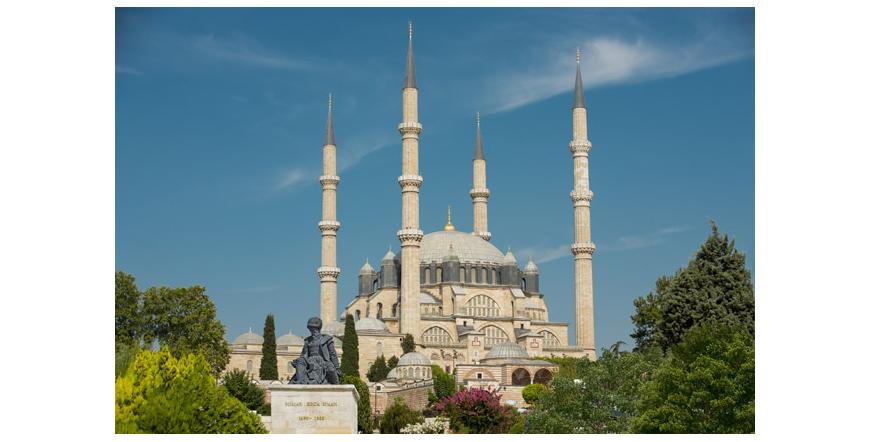
Edirne is a city in the northwestern Turkish province of Edirne in the region of Eastern Thrace, near Turkey's borders with Greece and Bulgaria. Edirne is famous for its many mosques, domes, minarets and palaces from the Ottoman period. The mosques in Edirne compete in beauty with the Blue Mosque in Istanbul. The city is a shopping center for fabrics, silks, carpets and agricultural products.
Edirne became the third capital of the Ottoman Empire in the period from 1369 to 1453, before Constantinople (present-day Istanbul) became the fourth and last capital of the empire between 1453 and 1922. The city was founded as Adrianople and was named after the Roman Emperor Hadrian. This name is still used in modern Greek. The Turkish name Edirne is of Greek origin. The name Adrianople was used in English, while the adoption of the Latin alphabet in 1928 made Edirne an internationally recognized name.
In Greek mythology, Orestes, son of King Agamemnon, built present-day Edirne under the name Orestias at the confluence of the rivers Tondus (Tundzha) and Ardiscu (Arda) with the river Hebrus (Maritsa). The city was re-founded by the Roman emperor Hadrian on the place of a former Thracian settlement known as Uskadama, Uskudama, Uskodama or Uskudama. It was the capital of the Bessi. Adrian developed it, decorated it with monuments and changed the name of Adrianople. It turned Edirne into the capital of the Roman province of Thrace. Licinius was defeated there by Constantine I in 323, and Emperor Valens was killed by the Goths in 378 during the Battle of Adrianople.
In 813, Edirne was temporarily confiscated by Khan Krum from Bulgaria, who moved his inhabitants to the Bulgarian lands north of the Danube.
During the existence of the Latin Empire in Constantinople, the Crusaders were decisively defeated by the Bulgarian Emperor Kaloyan at the Battle of Adrianople in 1205. In 1206, Adrianople and its territory were handed over to the Byzantine aristocrat Theodore Branas as hereditary power from the Latin regime. Theodore Comnenus, despot of Epirus, conquered it in 1227, but three years later was defeated at Klokotnitsa by Emperor Ivan Assen II.
In 1361, the Ottoman Empire, ruled by Sultan Murad I, invaded Thrace. Murad conquered Adrianople, probably in 1369. The city acquired its present name - Edirne. Murad moved the Ottoman capital to Edirne. Mehmed The Conqueror - Sultan Mehmed II, was born in Edirne. The city remained the Ottoman capital for 84 years, until 1453, when Mehmed II turned Constantinople into the capital. Under Ottoman rule, Edirne was the capital of the administrative unit. Sultan Mehmed IV left the palace in Constantinople and died in Edirne in 1693.
During his exile in the Ottoman Empire, Swedish King Carl XII remained in the city for most of 1713. Bahá'u'lláh, the founder of the Bahá'í Faith, lived in Edirne from 1863 to 1868. He was expelled from the Ottoman Empire before being exiled to the Ottoman penal colony in Acre. He mentions Edirne in his writings as the "Land of Mystery."
Edirne was briefly occupied by Imperial Russian troops in 1829 during the Greek War of Independence and in 1878 during the Russo-Turkish War of 1877-1878. The city was damaged by fire in 1905. Edirne is a fortress with great importance, which defended Ottoman Constantinople and Eastern Thrace during the Balkan Wars in 1912-1913. It was briefly occupied by the Bulgarians in 1913, after the siege of Edirne. The great powers - Britain, Italy, France and Russia - forced the Ottoman Empire to cede Edirne to Bulgaria at the end of the First Balkan War, which created a political scandal in the Ottoman government in Istanbul, which in turn led to the 1913 Ottoman coup. Edirne was occupied by the Greeks between 1920 and 1922, when the Greeks were defeated in the Greco-Turkish War.
Located 7 km from the Greek and 20 km from the Bulgarian border, Edirne is famous for its many mosques, domes and minarets. Selimiye Mosque, built in 1575 and designed by Turkey's greatest architect, Mimar Sinan, is one of the city's most important monuments. The huge amount of light passing through the numerous windows in the mosque shows its exquisite interior. The Selimiye Mosque has the tallest minarets. There are four of them and an unforgettable view of Edirne.
Climbing to the top of the 71-meter minaret is difficult, but the view from the highest point in the city is worth every physical effort. It has two balconies for viewing. This mosque is considered a masterpiece of Islamic architecture and as such was included in the UNESCO World Heritage List in 2011. If the Selimiye Mosque is not enough for someone, we recommend visiting the complex of the Sultan Beyazit II Mosque. The complex was commissioned by Sultan Beyazit II and was built between 1484 and 1488.
The architecture of this complex is subordinated to Ottoman architectural design. It consists of several buildings built around a mosque, the mosque being the heart of the complex. This complex contains a hostel for passengers, a shelter, a medical school and a hospital. In 1997, the former hospital complex was turned into a health museum dedicated to the history of medicine. This museum is the only one of its kind in Turkey and is the second most visited attraction in Edirne, after the Selimiye Mosque.
Other notable mosques are Eski Camii (Old Mosque) and Burmali Camii (Snake Mosque). Apart from the mosques, Edirne has other tourist attractions to be proud of. The most remarkable among them is the Edirne Palace, located in the Saraichi district. It was built during the reign of Murad II and although the palace buildings and its bathroom were demolished, the palace door and the palace kitchen were restored. The "Garden of Justice", built as part of the palace complex, stands intact next to the small Fatih Bridge over the Tundzha River.
Another notable building in Edirne is the Museum of Bayezid II Culier, which is an important monument with a complex structure, including many facilities used in those days.
The Balkan Wars Memorial Cemetery is located near the Edirne Palace, and features a monument to an unknown Ottoman soldier, in which it "guards" its entrance. The historic Great Synagogue in Edirne, abandoned and destroyed years ago, was restored in 2015 and opened to the public. Edirne once had a thriving Jewish community of about 20,000. They visited this synagogue, which could accommodate up to 1,200 people (900 men and 300 women). It is the third largest temple in Europe and the largest temple in all of Turkey.
Unfortunately, the temple was abandoned in 1983 as the Jewish population declined sharply due to the growing wave of anti-Semitism in the area. The synagogue was restored in 2015 and now functions as a museum, wedding venue and place of worship for the few local Jewish people in the area.
Edirne has three historically covered bazaars: Arasta, located next to the Selimiye Mosque, Bedesten next to Eski Camii and Ali Pasha. The Ali Pasha Bazaar in Edirne is a covered market designed by Mimar Sinan in 1569. It is decorated with red and white stone arches and has six different gates. Like the Grand Bazaar in Istanbul, this atmospheric market is much smaller, with over 130 sellers selling everything.
There are many things that you can do in Edirne. One of them is just a walk through the streets of the city, which are lively, full of locals who go with their families, drink coffee, play backgammon and more. One of the best things you can do if you are in Edirne is to visit and try the authentic Ottoman cuisine in the Tulipa Café and Restaurant. The restaurant is located in a beautifully restored historic mansion. Its mission is to preserve local Turkish traditions through its exquisite culinary offerings.
There are a few important and basic things to know about Edirne and one of them is quite fun - Edirne hosts a world famous festival to fight with oil every summer.
Vote:
Rating 5 from 1 voted
More sights in Turkey


Weather in Edirne

27.63 °C
Wind: 3.85 m/s
Humidity: 39 %
Pressure: 1017 hpa
Clouds: 0 %
Wind: 3.85 m/s
Humidity: 39 %
Pressure: 1017 hpa
Clouds: 0 %