

Troy
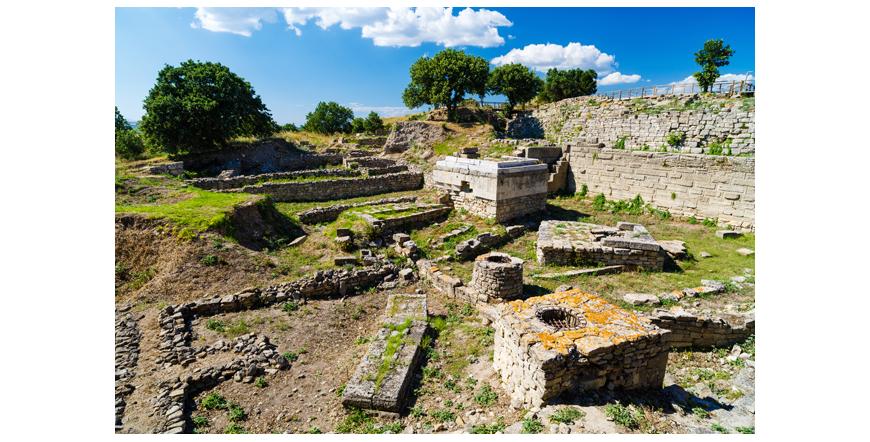
Troy is an ancient city in modern Turkey, located in the far northwest of the region, known in late classical antiquity as Asia Minor, now known as Anatolia. The city is just on the south of the southwestern part of the Dardanelles, not far from the Aegean coast, and northwest of Mount Ida. The modern location of the city is known as Hisarlik. The Trojan War, described in one of the two epic poems attributed to Homer, "burned" in this city in the past. Troy was inscribed on the UNESCO World Heritage List in 1998.
A new capital, called Ilion, was founded on the place of present city by the Roman emperor Augustus. The city prospered until the founding of Constantinople, became a
bishopric, but the importance gradually began to wane during the Byzantine era. For years, Troy was unguarded and therefore the subject of numerous looting.
The existence of Troy is highly disputed, but the mystery surrounding the city's existence begins to unravel with excavations carried out after 1860. In 1865, English archaeologist Frank Calvert began exploratory excavations in a field he had bought from a local farmer in Hisarlik. In 1868, Heinrich Schliemann, a wealthy German businessman and archaeologist, also began excavations in the area after a chance encounter with Calvert at Canakkale. These excavations reveal several cities built in succession.
Initially Schliemann was skeptical about identifying Hisarlik
with Troy, but was persuaded by Calvert and took over Calvert's excavations in the eastern half of the place Hisarlik, which was owned by Calvert. Troy is identified with a city called Vilusa by the Hittites and is generally identified with Homeric Troy.
Today, the hill in Hisarlik gives its name to a small village near the ruins, which supports tourist trade when visiting the archeological site of Troy. It is located in the province of Canakkale, about 30 km southwest of the capital of the province, also called Canakkale. Due to its location - Troy is close to the Aegean Sea, the Sea of Marmara and the Black Sea, the city became a center for military and commercial purposes.
In the summer of 2006, excavations continued under the direction of Corfman's colleague Ernst Pernika with a new digging permit. In 2013, an international team led by William Eylard, an archaeologist at the University of Wisconsin-Madison, had to conduct new excavations. The new technique of "molecular archeology" had to be used for these excavations. A few days before the Wisconsin team began its expedition, Turkey revoked about 100 excavation permits, including that of Wisconsin.
In March 2014, it was announced that new excavations would be carried out, which would be sponsored by a private company and conducted by Canakkale University. This is the first Turkish team to dig. The excavations and research are planned to last 12 months and will be led by Associate Professor Rustem Aslan. The university's rector said that "the parts discovered in Troy will contribute a lot to the culture and tourism of Canakkale. Perhaps this will become one of the most important historical place in Turkey."
The walls of Troy, originally built during the Bronze Age between 3000 and 2600 BC, are the main defense of the city. The remains of these walls have been studied through the above-mentioned excavations, which shed light on the historic city itself. The fortifications show the importance of defense and how war was an important issue for the ancient cities.The walls surround the city, stretching for several hundred meters, and at the time they were built, they were over 5 meters high. They were built of limestone, with watchtowers and brick fortifications, and erected mounds that served as protective barriers. During all phases, the walls served as the largest fortification that protected the Trojans from their enemies. Defense mechanisms, such as the walls of Troy, shed light on the subject of war in ancient times.
Troy Museum is an archeological museum located near the archeological site of the ancient Greek city of Troy, in northwestern Turkey. Opened in 2018, it features historic artifacts from Troy and some other ancient cities around and on nearby islands.
The ruins must be considered. Troy was destroyed and rebuilt nine times, and from each of the nine layers of the rebuilt city there is still something left to this day. Climbing the stairs of the reconstructed Trojan horse at the entrance of the archeological site is a mandatory part of every tour of Troy. It is good to do on weekdays, as the stairs (and the inside of the horse itself) can be overcrowded on the weekends by students on a school trip, for example.
Vote:
Rating 5 from 1 voted
More sights in Turkey


