

Konya
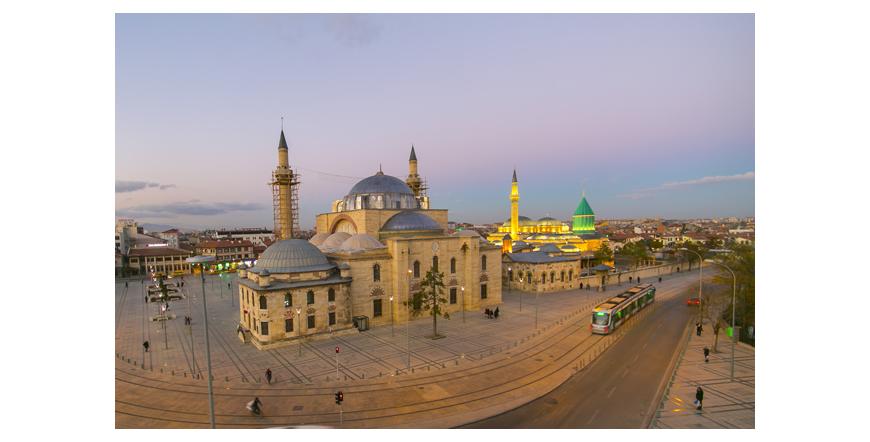
Konya flourished under Roman rule and sheltered one of the first church councils in 235. It was revived in the early thirteenth century, during the reign of Aladdin Kayqubad I. This is the golden age of the Konya, which lasted until its conquest by the Mongol invaders. This is the homeland of the spinning dervishes.
The most visited place in Konya is the Mevlana Museum and the tomb of Mevlana Jalaluddin. The Mevlana Monastery became a museum in 1927. It is interesting to see the hermitages of the dervishes. In a separate room on a pedestal is the huge tomb of Mevlana. The stretcher is covered with a brocade table embroidered with gold thread and weighing almost 41 kg. The believers press their foreheads to the sacred silver steps that lead to the platform of the tomb. This is an extremely important place for believers and an interesting attraction for tourists.
The beautiful Alaadin Mosque was completed in 1220 and now restored crowning Alaadin Hill. The mosque is in Syrian style. Its pulpit is surrounded by 42 columns taken from Roman temples. Buyuk Karatay Madrasa is a theological seminary founded by Ameer Jalaluddin Karatay in 1251. The madrasa is now an outstanding museum of ceramics. The slender minaret seminary from the 13th century has a minaret decorated with blue glazed tiles. It is now a museum, also called Ince Minare, which has a nice collection of stone and wood carvings.
The Crystal Seminary was opened in 1242 as a school of Islamic jurisprudence. Rich slab decoration provides a majestic home for the Turba Museums (Museum of Funeral Monuments). The building of the remains of the Sahit Ata complex from 1283 has been turned into an Archaeological Museum. The most interesting is the marble panel from the III century BC. with the twelve feats of Hercules.
Vote:
Rating 1 from 1 voted
More sights in Turkey


_23243.jpg)


_00543.jpg)


