

Vienna, Austria
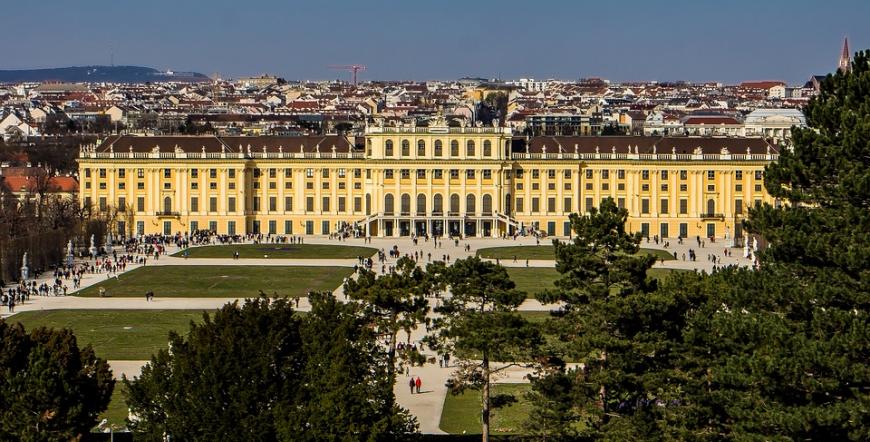
Vienna (in Latin Viena, in German Wien) - a source of imperial power and the final point of the journey of anyone who decided to leave his mark on world history. Standing in the center of Europe, Vienna is a bustling metropolis, the capital of Austria, a city with the status of its province. It is located near the Czech Republic, Slovakia and Hungary, on both banks of the Danube River, 40 km from the Slovak border and 50 km from its capital Bratislava.
Vienna is a city bursting with attractions, a palette of alternating beautiful relics of the imperial past with glitzy shopping districts, a mix of cultural centers and unconventional contemporary architecture. In 2001, the city center of Vienna was included in the UNESCO World Cultural and Natural Heritage List. Vienna is the seat of the Archdiocese of Vienna of the Roman Catholic Church.
Vienna is a city of exceptional economic and political importance. The city is the headquarters of a number of UN organizations and other intergovernmental organizations such as the United Nations Industrial Development Organization (UNIDO), the Organization of the Petroleum Exporting Countries (OPEC), the International Atomic Energy Agency (IAEA), as well as many other international institutions and companies.
Writing the history of Vienna is not an easy task, because these are annals, long and varied. It records that the settlement of the territory of today's Vienna began during the Neolithic. Then the Danube attracts many people because of the favorable conditions it offers for the development of agriculture and animal husbandry - fertile soils, abundant water sources and a favorable climate.
In fact, Vienna as a settlement began to develop in the middle of the 1st century. It was then that the construction process was started on the territory of today's old city of an outpost of the 15th Roman legion. They gave it the name Vindobona and, parallel to the military camp, a small town began to take shape and develop. A huge and devastating fire in Vindobona at the beginning of the 5th century forced the Romans to start leaving these places. However, the topography of today's Vienna shows that immediately after the withdrawal of the Romans, other people found refuge near the then-preserved walls and used the remaining materials to build their homes.
A few centuries later, in the 9th century, the Carolingians came to the territory of today's Vienna from the west, and built a small castle and the church of St. Ruprecht, which has survived to this day, in the northeastern part of the former Roman camp. The houses are few, the settlement that appears on the map is not yet of great importance.
Again three centuries later, Vienna became the seat of the Austrian Babenberg ducal dynasty. From 1278, Vienna became a stronghold of the Habsburg dynasty, which in turn made it a center of culture, science, music and fine cuisine. In 1469, Emperor Frederick III obtained from Pope Paul II the right to establish a bishopric in Vienna.
In 1529, the Ottoman Empire made an unsuccessful attempt to lay siege to Vienna, and the heavy defeat of the Turkish army put an end to the rapid expansion of the Ottoman Empire in Europe. In 1679, however, a plague epidemic ravaged today's Austrian capital Vienna, the city's population decreased by about a third. In 1693, the Plague Column was erected in the center of the city, whose role was to be a monument to deliverance from the epidemic. But this obviously did not save the population, and in 1713 another wave took the lives of thousands of victims, only 11,000 of whom were buried in the catacombs under St. Stephen's Cathedral. As a reminder of these sinister times in the city's history, the majestic Karlskirche edifice was erected.
Golden ages came for Vienna - in the 16th century, the city was elevated to the capital of the multinational state of the Austrian Habsburgs, and in the 17th and 18th centuries, the city was the center of the numerous court bureaucracy. At the same time, the beginning of a manufacturing industry was established, with the development of textile production and the production of luxury goods. In addition, Vienna became a leading center of European culture. But apart from sunny days, since that time it is recorded in the history of Vienna that in 1805 and 1809 the city was twice occupied by Napoleon's troops. In 1805, after the collapse of the Holy Roman Empire, the city became the capital of the Austrian Empire and later of the Austro-Hungarian Empire.
In the 19th century, Vienna was again at its peak. With the advent of the Biedermeier style, invented and developed by famous Viennese composers, artists and theater actors, the city rapidly developed culture and the arts. At the end of the same century, culture, science and education continued to flourish in Vienna, and the University of Vienna and the Academy of Sciences gained worldwide recognition.
By the beginning of the 20th century, Vienna was already one of the largest cities in Europe, with a population of over 2 million people. In 1918, after World War I, the city became the capital of the First Austrian Republic. After 1945, Vienna again became the capital of Austria.
Moving from history to culture, there is much to tell. Vienna has been a center of art and culture for centuries, establishing itself as a factor in areas such as theater, opera, classical music and fine arts. The Imperial Theater is among the best theaters in the German-speaking world, and the National Theater and the Josefstadt Theater also stage high-class productions. Many small theaters have also opened their doors in the city, but they should not be underestimated, regardless of the fact that in most cases they perform less popular forms of performances, such as modern, experimental plays or cabaret. The opera is the other jewel in the crown of Vienna's culture. The Vienna State Opera and Vienna State Opera offer something for everyone, and classical music concerts are also held in the famous concert hall of the Vienna Music Society, home of the Vienna Philharmonic and the Vienna Concert Hall.
The museums and galleries of Vienna should not be passed lightly. The country has many treasures left as the legacy of this great nation. The treasury of the Hofburg Imperial Palace houses the jewels of the Habsburgs. In the Museum of Queen Elisabeth of Austria you can see the imperial apartment and the silver cabinet, and in the Natural History Museum and the Museum of Art History, located opposite the Hofburg, there are expositions with many paintings by old masters and antique and classical works.
In Vienna, there is a separate Museum Quarter, in which many museums are organized. The Museum Quarter is a former imperial stables that was converted into a museum complex in 1990. It houses the Museum of Modern Art (Ludwig Foundation), the Leopold Museum (which mainly displays works from Viennese Modernism and Austrian Expressionism) and additional halls with temporary exhibitions. Liechtenstein Palace houses one of the largest private collections. There are also numerous other permanent exhibitions – the Museum of Military History, the Museum of Technology, the Vienna Clock Museum, the Burial Museum, etc.
Besides culture, Vienna is a center of education. The city has numerous scientific institutions and universities, some of which are world-renowned. These are Austrian Institute for Economic Research, Vienna Institute for International Economic Research, University of Vienna, Vienna University of Technology, Vienna University of Economics, University of Agriculture (for Natural Resources and Applied Sciences), Vienna Medical University, Academy of Fine Arts, University of Applied Arts , Vienna University of Music and Performing Arts, University of Veterinary Medicine. Besides the public universities, several private universities have been established in Vienna - Webster University, MODUL University and Sigmund Freud University.
Perhaps the doubt has crept into no one that Vienna is a city without sights. Vienna is a city that has succeeded in uniting its historical heritage with the spirit of the new era. Vienna simply has something for everyone.
Among the major tourist attractions are the Hofburg and Schönbrunn imperial palaces (home to the world's first zoo, the Schönbrunn Zoo), as well as numerous art galleries (including the Albertina, in the Belvedere Palace and in the Museum Quarter). The Ferris wheel in the Pratera amusement park and the Danube Tower also attract many visitors.
Since Austria is famous for its composers, it is logical that the places associated with the great composers who lived in Vienna are among the most visited places - these are the house where Mozart lived, the golden statue of Johann Strauss. Because of the many artists of outstanding importance that it has hosted, Vienna is known as the "City of Music" or the "Capital of the Waltz Step".
Vienna is rich in churches, the most famous of which is St. Stephen's Cathedral, which is one of the symbols of the city. There are also modern attractions – the Gasometer, the Millennium Tower and the Vienna International Center. Cultural attractions include the Imperial Theater and the Vienna State Opera.
Vienna is a place that ignites our imagination and desires to visit the city with its fast waltzes and beautiful opera house, Spanish riding school and traditional cafes. But apart from all the history and traditions, the city also has a very different side that is youthful, modern and inventive.
Vote:
Rating 5 from 1 voted
More sights in Austria


Weather in Vienna, Austria

27.13 °C
Wind: 11.32 m/s
Humidity: 58 %
Pressure: 1007 hpa
Clouds: 0 %
Wind: 11.32 m/s
Humidity: 58 %
Pressure: 1007 hpa
Clouds: 0 %