

St. Charles Church, Vienna
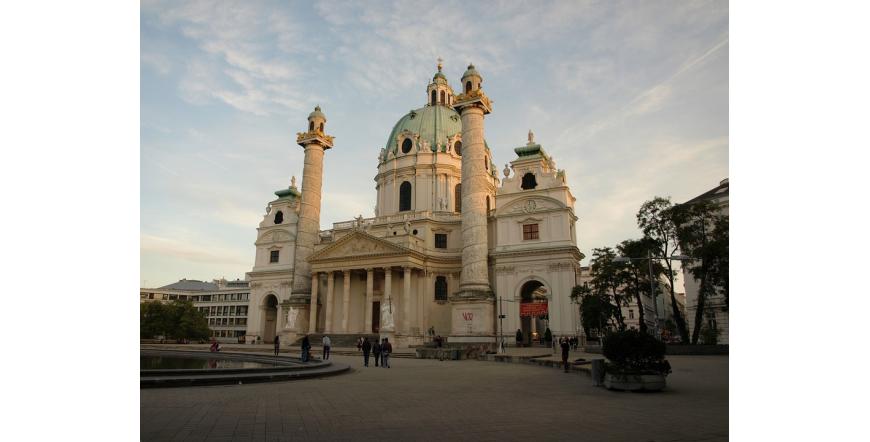
The St. Charles Church, along with the Belvedere Palace, are some of the main emblems of the Baroque architecture of the Austrian capital Vienna. The St. Charles Church is one of the most splendid Baroque churches north of the Alps and is distinguished by its whimsical architectural appearance, a mixture of styles from Roman times to the Middle Ages and the Renaissance. The architects Peter von Prahatica, Hans Puxpaum and Anton Pilgram are credited with the construction and rebuilding of the St. Charles Church. The interior of the St. Charles Church is believed to be much more conventional compared to the exterior. Beautiful frescoes depicting the life of Borromeus can be seen everywhere. Today, St. Charles has been turned into a museum, which is worth a visit especially for the opportunity to climb to the top of the Karlskirche, from where one can enjoy a magnificent view of the whole of Vienna. This beautiful and rather unusual temple of faith can be found in the district of Viden, next to the Vienna Technical University, the opera house and the Belvedere Palace. Vienna's St. Charles Church is one of the most magnificent baroque churches north of the Alps, and its mighty 72-metre-high dome dominates the cityscape. In 1738 the church was handed over to the Crusading Order of the Red Star of Prague and until 1918 was under the patronage of the Kaiser. Between 1989 and 2000, however, authority over the church was handed over to the prelature of Opus Dei.
The appearance of the St. Charles Church is noted as a donation made to Kaiser Charles VI after the terrible plague epidemic of 1713 and represents the late Baroque sacral building dedicated to the patron saint and healer of plague epidemics, Charles Borromeo. The foundations of St. Charles Church were laid in 1716 under the supervision of Anton Erhard Martinelli. It is said that the official sum spent on the erection of the Baroque temple amounted to 304,045 guilders, 250,000 of which were collected from the Jews living in Vienna in the form of a tax. The construction of the St. Charles Church between 1716 and 1722 was led by the main actor Johann Bernhard Fischer of Erlach. After the architect's death, the construction of St. Charles Church continued and, after some changes were made to his design in the period 1724 - 1739, his son Josef Emanuel completed the imposing building. Also known as the Karlskirche, St. Charles Church is the unique creation of these two architects, who bequeathed Vienna one of its most beautiful and interesting buildings, combining elements from different architectural styles.
The building of St. Charles Church is definitely distinguished by its two columns in front of the main entrance /definitely the most striking moment of the overall architecture of the church/, on which spiral frescoes and relief images depict moments from the life of Charles Borromeo. Their role is to recall the columns of Heracles and to symbolise the power of the Kaiser. Like many temples around the world, such as the Temple of Solomon and St. Sophia in Constantinople, the Karlskirche is a combination of different architectural influences. An example of this are the two columns with bas-reliefs from the life of St. Charles Baromeus, which look an awful lot like minarets, and are borrowed from Trajan's Column in Rome. Specialists in this field also point to other recognized influences in architecture, such as those of Bernini and the Parisian Minorite Church, and with the dome in the Vatican's St. Peter's. Peter's in Rome, painted by Michelangelo.
Passing over the dome of the Karlskirche, we should specify that the frescoes on it are the work of Michael Rothmeyer. Also between 1725 and 1730, besides the monumental dome fresco, the plaster decorations on the walls were done by Albert Camesina, the altarpieces by Sebastiano Ricci, Daniel Gran, Martino Altomonte and Jacob van Schupen.
Vote:
Rating 5 from 1 voted
More sights in Austria


