

Copenhagen, Danmark
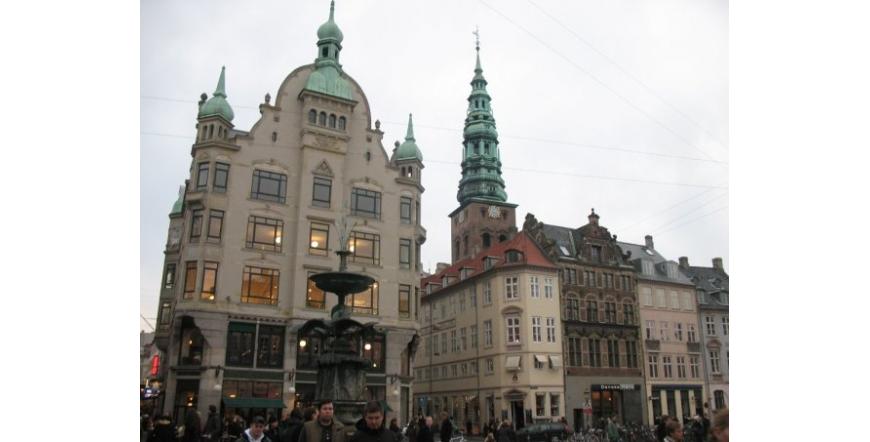
Surrounded by water, be it sea or canal, and connected by permanent and movable bridges, Copenhagen has the indelible atmosphere of a seaside city.
1. In Amalienborg Palace, Copenhagen, the members of the royal family spend the spring and summer. When they return to their main residence in the autumn, as they have done since 1784, the Royal Guard and band march at noon through the city for the changing of the palace guard. Among the exhibits at the Castle Museum are the study of King Christian IX (1818-1906) and the living room of his wife Queen Louse. Yachts visiting the castle harbor can also be seen, as well as modern sculptors and Amalienborg Palace's meticulously arranged flower beds.
2. The Copenhagen Botanic Garden, spread over 25 acres, has a spectacular Palm Pavilion, in which tropical and subtropical plants thrive. The area also has an observatory, geological museum and the Cactus and Orchid Pavilion.
3. Granite elephants guard the entrance to the first Carlsberg brewery, opened in 1847.
4. The Little Mermaid statue in Copenhagen was created in 1913 to commemorate the self-sacrifice for love of the heroine created by Hans Christian Andersen.
5. At the Freedom Museum in Copenhagen, moving displays recall the heroic Danish resistance movement in World War II that saved 7,000 Jews from the Nazis.
6. Once surrounded by two rings of moats, Copenhagen Citadel was the city's main fortress in the 18th century, but during World War II, the Germans used it as their headquarters. The beautiful park around it, cut by paths and alleys, is a favorite place for the Danes to relax.
7. Copenhagen's Column of Lure Blowers, erected in 1914, with two Vikings at the top blowing an ancient trumpet called a lur, represents an artistic liberties – the lur dates back to the Bronze Age, 1500 BC, while the Vikings lived only 1000 years ago.
8. The massive marble church in Copenhagen is a baroque church that was begun in 1749 and finally completed and consecrated in 1894. Around it are arranged 16 statues of religious leaders, from Moses to Luther, and below them are sculptures of famous Danish priests and bishops.
9. The new Carlsberg sculptor's museum in Copenhagen is an elaborate neoclassical building housing one of Europe's largest collections of Greek and Roman antiquities and sculptors.
10. Copenhagen's City Hall Square is the center of Copenhagen's shopping district. The City Council is a Renaissance-style building completed in 1905. A statue of Copenhagen's 12th-century founder, Bishop Absalon, is above the main entrance. Inside you can see the first World Clock - an astronomical time measuring device invented and built by Jeus Olsen, which went into operation in 1955.
11. Rosenberg Castle in Copenhagen is a Renaissance palace built by Christian IV. It houses the Crown Jewels as well as a collection of costumes and royal regalia. It is interesting to see the pearl-encrusted saddle of Christian IV.
12. The Round Tower in Copenhagen was built as an observatory in 1642 by Christian IV. Russian Tsar Peter the Great is said to have driven a horse in a carriage up the 600 steps of the inner staircase of this round tower.
13. Tivoli Gardens are more than just a fair. In 1840, the Danish architect Georg Carstenesen convinced King Christian VIII that an amusement park would be great for people. Tivoli offers a pantomime theater and outdoor stage, elegant restaurants and frequent classical, jazz and rock concerts, as well as a museum tracing its own history.
14. The Tycho Brahe Planetarium in Copenhagen is a modern, cylindrical building full of astronomical exhibits. There is also an Omnimaxtheatre, which takes the visitor on a simulated journey into space and into the depths of the sea.
15. The Church of the Our Saviour in Copenhagen is a Gothic building dating from 1696. Legend has it that the staircase winding around the fantastic green and gold tower originally wrapped around the other side and when the architect reached the top and saw what he had done, he jumped off the tower.
Vote:
Rating 5 from 1 voted


Weather in Copenhagen, Danmark

20.3 °C
Wind: 1.03 m/s
Humidity: 76 %
Pressure: 1007 hpa
Clouds: 100 %
Wind: 1.03 m/s
Humidity: 76 %
Pressure: 1007 hpa
Clouds: 100 %