

Olomouc, Czech Republic
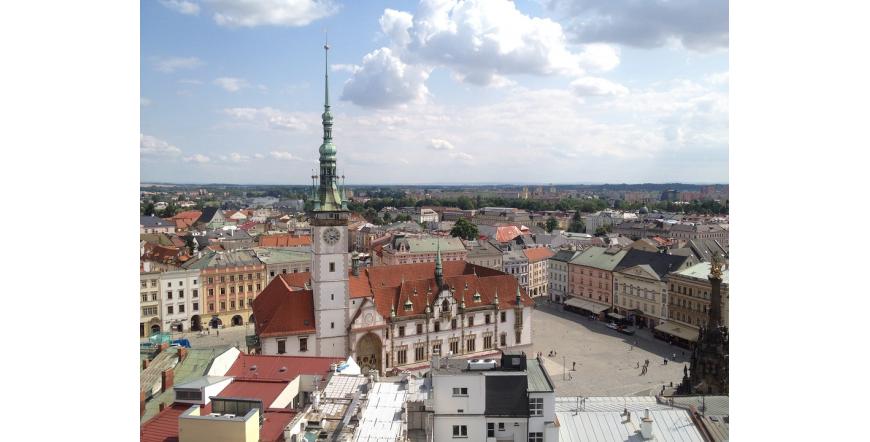
The capital of Moravia until 1641, today Olomouc is a thriving industrial and university Czech city. This pleasant city offers its visitors an unforgettable stroll along its wide boulevards, along which are perched old seminaries, solid 19th-century housing blocks, green parks, baroque fountains and majestic university buildings.
The history of Olomouc tells us that it originated in the 7th century, when a settlement appeared on this site. The year 1063 is memorable for Olomouc, because then the city acquired the status of a bishopric, and the 16th century is emblematic, because these were the years of prosperity. Unfortunately, Olomouc was another Czech town to which the Thirty Years' War was merciless, inflicting lasting consequences. The town later awoke to life again, despite Brno having already
been named its capital.
The heart of the old part of Olomouc beats in two lively squares, the Horní Namnesti and the Dolní Namnesti.
"Horní namnesti is a huge square and in the middle of it stands the Renaissance town hall. Also impressive is the huge 35-metre-high "Column of the Holy Trinity" with sculpted figures of falling angels. This column was erected in 1754 and is the largest among thousands of similar columns in the whole of Bohemia. The square is also home to a neoclassical theatre designed by Josef Kornhuisel in 1830. The young composer Gustav Mahler chose this theatre as his creative territory in 1883.
Next door to the Horní Namnesti in Olomouc is the Lower Namnesti. It is also decorated with fountains and a plague column, while the Howenschild Palace stands out among the Renaissance residential buildings.
The Gothic church of St. Maurice with its battlement-like tower is more interesting inside than outside. Its gloomy exterior is contrasted by Baroque and neo-Gothic decorations on the interior, beneath which stand out the tall Gothic columns and ribbed vaults. The church owes its fame to an organ dating from 1745, and every year in September it hosts an organ music festival. The ornate plague (Marian) column also adorns the "Lower Namnesti" in the old town of Olomouc.
On the other side of the "Horni namnesti" is the church of St. Michael with its three domes and baroque pomp, all part of its interior. Nearby is the small 20th century Sarkander Chapel. It is a small and vaulted Baroque shrine honouring the Catholic priest Jan Sarkander, who was tortured to death in 1620. The Jesuit Church of St. Mary of the Snows in Olomouc from the early 18th century is located on Namnesti Republiki.
There are also two interesting museums in Olomouc - the "Museum of Art", featuring Danish paintings from the 16th-18th centuries and exhibits related to the history of Olomouc, and the "Vlasteveden Museum" has a natural history collection.
Another major attraction of Olomouc is the exquisite Archbishop's Palace, dating from the 17th century. In 1848, the young Franz Josef was proclaimed Emperor of Austria there. Reconstructed in the 1880s and having lost its original Romanesque style, St. Wenceslas was enlarged and converted into a Baroque cathedral. Its famous treasury is located in the crypt filled with reliquaries.
Next to Olomouc Cathedral are the remains of the Bishop's Palace, from which excavations have found double Romanesque windows, a Gothic gallery and a chapel with 16th-century frescoes.
Vote:
Rating 5 from 1 voted
More sights in Czech Republic


