

Cheb, Czech Republic
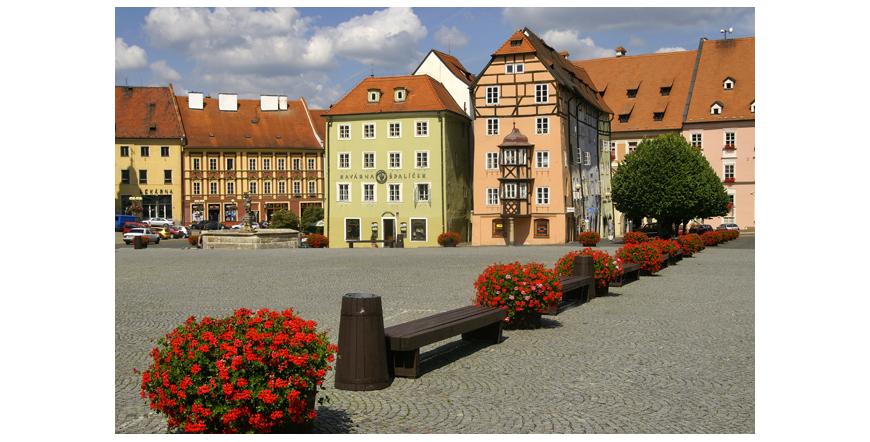
Cheb is a town in the Karlovy Vary region of Bohemia, known before World War II as Eger. In general, Cheb is an industrial town, but its jewel, its historic center, is a must-see. Numerous buildings with wooden beams give Cheb the appearance of a typical small German town, which is not surprising given Cheb's location just 6 km from the German border.
Germans settled in Cheb in the 11th century, making the town an important trading center between Bavaria and Bohemia. It was not until 1322 that Cheb added its lands to the Bohemian kingdom.
Because of its strategic location, Cheb suffered severely during the Thirty Years' War, as both belligerents used it as their base. The industrialization of the town in the 19th century succeeded in bringing Cheb back to the ladder of prosperity. Around the main square of Cheb, shaped like an arrow, there are unexpectedly tall buildings, most dating from the 17th century. Their style is more German than Czech, and this is not surprising given the long period of German presence in these lands. For many years it declined and suffered from the rulers' disinterest in it, but today life here is bustling, and numerous cafes and restaurants have sprung up along the way. At the top end of the steep square of Cheb is the famous Roland Fountain, and at the bottom end is the group of medieval timber-beamed houses known as the "Spaliczek", once inhabited by Jewish merchants.
The street opposite the town hall leads to one of Cheb's landmarks, the former Franciscan monastery with a delightful 14th-century gallery and the adjacent 18th-century church of St. Clara. Opposite the "Spalicek" are some of the town's impressive houses. Among them are a house with an imposing high gable and a beautiful Gothic portal, and the "Gabler House" with its lavish stucco decoration, where Goethe often stayed. The Hebe Museum is also on this square, and is famous for the fact that General Albert von Waldstein was assassinated in it in 1634. In this museum a reenactment has been made in which the assassination that took place on the orders of Ferdinand II.
Today, only the towers remain of the originally Romanesque and later neo-Gothic St. Nicholas Church, located behind the Hebe Museum.
It is impossible not to have a castle in Cheb. Unfortunately, only the central black tower, built of volcanic stone, remains of the "Temple of Cheb". The castle was built in the 12th century as a fortress and palace by order of the Holy Roman Emperor Frederick I Barbarossa. Nearby is the secularised chapel of St Bartholomew from 1414, where a collection of Gothic sculptures can be seen.
Vote:
Rating 5 from 1 voted
More sights in Czech Republic


Weather in Cheb, Czech Republic

23.02 °C
Wind: 0.55 m/s
Humidity: 70 %
Pressure: 1007 hpa
Clouds: 91 %
Wind: 0.55 m/s
Humidity: 70 %
Pressure: 1007 hpa
Clouds: 91 %