

St. Vitus Cathedral, Prague
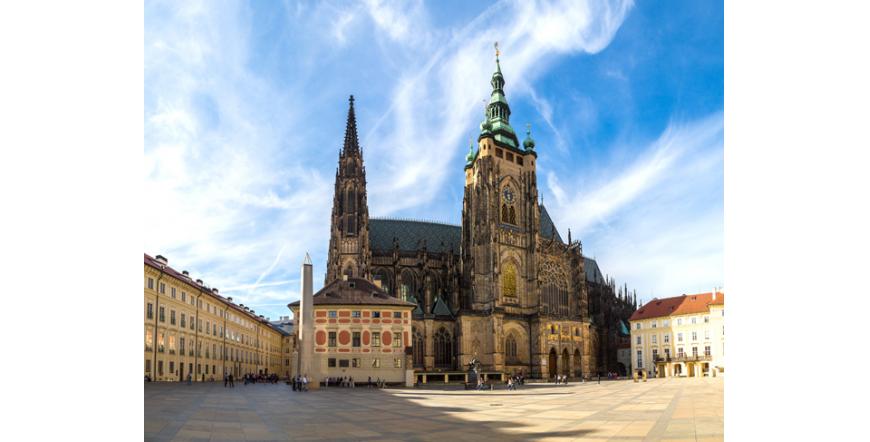
One of Europe's admirable Gothic cathedrals can be seen in the Czech Republic, in the third courtyard of Prague Castle. It has been appointed the seat of the archbishop of the city, and rises majestically from the hill above the Vltava. The full name of the cathedral, given to it in 1989, is St. Vitus, St. Wenceslas and St. Vojtech. The relics of many of Bohemia's kings are enshrined there, and it is itself an excellent example of Gothic architecture and the most important church in the country. The history of St. Vitus Cathedral dates back to 925, when a rotunda church was erected on this place by Wenceslas I, Duke of Bohemia. St. Vitus was chosen as the patron of the church. Vitus was chosen as the patron of the church because Wenceslas received a sacred relic - the hand of St. Vitus. Witt's hand as a gift from Emperor Henry I. Another story says that the choice of patron was dictated by Wenceslas' desire to make Christianity more acceptable to the pagan population, and he chose St. Vitus because of its close resonance to Svetovit, a Slavic deity.
The cathedral of St. Vitus was built on the same name as the cathedral of St. Vitus is an imposing sight, and well worth the effort one makes to walk its perimeter. Opening the doors of St. Vitus, one feels a whiff of harmony emanating from its very interior. The altar is situated in the middle of the church choir, and in front of it is the wonderful imperial mausoleum. It was completed in 1589 and contains the relics of Ferdinand I, his wife Anna and their son Maximilian II. Their tombs were made by the Danish sculptor Alexander Colin between 1571 and 1589. To the right of the church choir, wooden reliefs by Caspar Bechteler give delight to the eye. One of them, for example, depicts the flight of Frederick V after the Battle of Billa Hora. Also impressive is the bronze statue of the praying Cardinal Bedřich, made by Jozef Myselbek.
The tomb of St. Vitus itself is located between the Chapel of St. Mary and the high altar, considered an extremely modest repository for his relics. Much more imposing and impressive is the tomb of St. Jan Nepomucki, surpassing even those of the rulers. History has it that in 1393, Wenceslas IV ordered Jan to be thrown into the Vltava River, and thus Jan was proclaimed the first Czech martyr, and a cult was erected to him, leading to his canonization in 1729.
St. Vitus Cathedral is rich in many chapels and tombs, some of which are regarded as real treasures - St. Adalbert with his four silver figures of saints, St. Waldstein and his tombstone in the handwriting of Peter Parler, etc. The royal tomb is in the Holy Cross Chapel, but St. Wenceslas has been erected as the most beautiful chapel. It was built between 1362 and 1367 by Peter Parler and the relics of the saint were placed there. The tomb itself is decorated with a silver bust of St Wenceslas and dates from the 20th century.
A walk through St Vitus Cathedral should not end without a look at the stained glass windows. One is by Alfons Mucha, the rose window is by Josef Klassak, and Max Schwabinski gave a lot of himself to make a huge stained glass window depicting the Last Judgement.
Vote:
Rating 5 from 1 voted
More sights in Czech Republic


Weather in St. Vitus Cathedral, Prague

25.02 °C
Wind: 3.09 m/s
Humidity: 54 %
Pressure: 1006 hpa
Clouds: 0 %
Wind: 3.09 m/s
Humidity: 54 %
Pressure: 1006 hpa
Clouds: 0 %