

Brno, Czech Republic
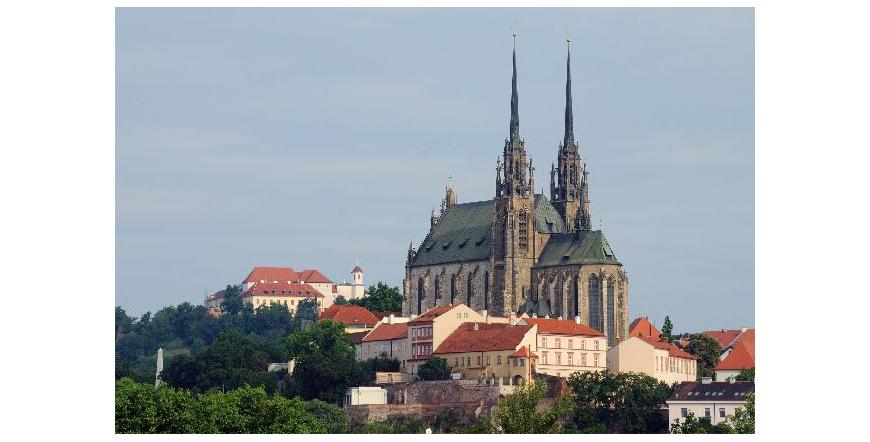
Brno is a city in southeastern Bohemia, the center of the South Moravian Region. The city is the second largest in the country and is located at the confluence of the Svitava and Svratka rivers.
Since the dissolution of Czechoslovakia, institutions such as the Constitutional Court, the Supreme Court and the Supreme Prosecutor's Office of the Czech Republic have been located in Brno. Historically, Brno was first mentioned in the 11th century, with evidence of an existing castle from that period, but evidence has been found that the area was inhabited as early as the 5th century. One thing is indisputable about the history of the town - Brno had an important defensive importance right up to the middle of the 19th century.
From the end of the 12th century Brno was the capital of a constituent principality, and in 1243 it was granted the status of a royal free city. At the end of the 13th century, Brno was chosen as the residence of the Moravian margraves. The Hussite wars did not miss the lands of Brno, but the town remained loyal to the king. In 1454 it was on his orders that all Jews were expelled.
The history of Brno also goes back through the reign of the Habsburgs and it was then known as Brünn. Brno acts as the economic and cultural center of Moravia, and international fairs are held there every year. During the Thirty Years' War it was besieged by Swedish troops in 1643 and 1645, and by Prussian troops in 1742. Brno was declared the center of the bishoprics in 1777.
A number of centers of science and culture are located in Brno. The city is home to the Branch of the Czech Academy of Sciences, the Tomas Masaryk University, the Leoš Janáček Academy of Musical Arts, the Moravian Art Gallery, and several museums: city, art and industrial, national technical, etc.
Brno is an industrial city, but its historic center is fascinating. Among the main architectural monuments in the historic center of the city are the Gothic Cathedral of Sts. Peter and Paul, the churches of St. James", "St. St. Thomas and St. Jan", the Gothic old and new buildings of the town government, and along with them - numerous buildings in the Renaissance and Baroque style - a theatre from the 15th century, as well as the Capuchin monastery from the 17th century, which
houses the graves of Czech nobles. Above Brno rise two hills, Petyr and Spilberk. At the top of Petrov is the Cathedral of Saints Peter and Paul, whose spindle-shaped towers can be seen from miles away. The Swedish attack during the Thirty Years' War inflicted lasting damage on its building, but it was subsequently rebuilt in the Baroque style by Morgic Grimm, and shortly afterwards the exterior and the entire church choir were transformed into the Gothic style in the early 20th century.
The Gothic church of St. James is the parish church of Brno with a characteristic high bell tower. Its Gothic elegance is somehow necessary among so many baroque-sounding of most religious monuments of Brno. St. Thomas Church is famous for its triple pulpit, and also for being next to the former Governor's Palace, designed by the Brothers Grimm.
The Dominican Church of St. Michael from 1655 is located behind the Old Town Hall and near the New Town Hall. Its imposing posture is due to its outstanding baroque statues and altarpiece The New Town Hall building is actually the former Dominican convent that the Brothers Grimm built in Brno in the 1690s.
The majestic building of the "Machen Theatre" is located to the left of the "Malinovskeho namnesti" in Brno. Its setting is lavish - it has beautiful staircases, chandeliers, lounges and a hall sunk in gold with three balconies.
Brno's notable 20th-century architectural landmarks include the Opera House, the International Industrial Fair and the Tugendhat Villa. The Augustinian Monastery in Brno is famous for being the place where Gregor Mendel conducted his experiments.
The fair chambers are located away from the center of Brno. They were built in 1928 and are still in use today. They are a field of expression for leading Czech architects working in the functionalist style. Villa Tugendhat is an important exhibit of 20th century architecture. It was built in 1930 to a design by Mies van der Rohe. The white, unadorned building of the villa is an example of the idea of 'free space layout' or the so-called 'open space' style.
Vote:
Rating 3 from 2 voted
More sights in Czech Republic


