

Old Town Square, Prague
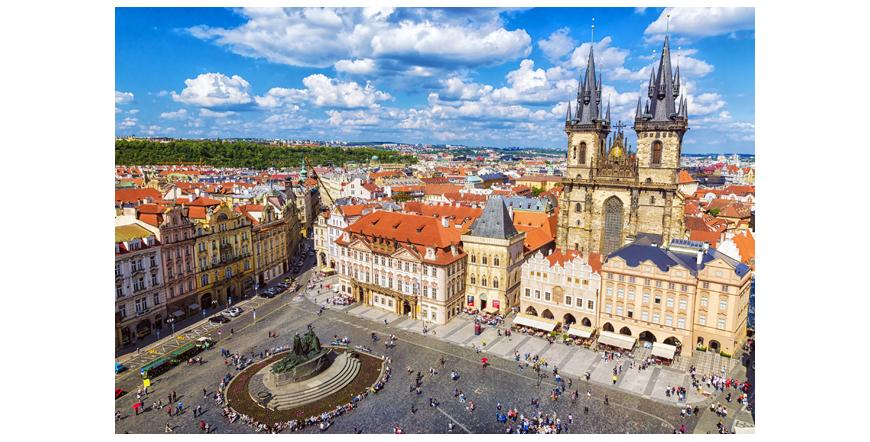
Residential buildings, palaces and churches enclose an area of Prague called Old Town Square, which is actually the heart of Prague. Most of the houses here were originally erected in Romanesque style, but their facades exude typical Baroque features. Being the centre of Prague's social life, Staromná Square has had this as a privilege since the Middle Ages, having experienced scenes such as executions and street battles, as well as a fateful moment for the country - in February 1948, Clement Gottwald proclaimed the coming to power of the communists and, consequently, the establishment of a communist state from the balcony of the rococo Golc-Kinský Palace. This palace houses the National Gallery's collection of prints and drawings.
Opposite this palace on the Old Town Square is a huge monument from 1915 dedicated to the great radical reformer Jan Hus. This evocative composition depicts the exile of the Hussite and Protestant warriors, while the statue of the young mother symbolises the national revival. Old Town Square is also home to another interesting building, the Gothic 'House with the Stone Bell', which until the 1980s towered with its baroque posture.
There can be no churches in Staromnenski Square and a proud representative of them is St. Mary's Church. Its twin towers make for one of the symbols of Prague. The construction of this temple was started in 1365 and despite its many changes it retains its Gothic atmosphere. The most interesting monument in the church is the tomb of the great Danish astronomer Tycho Brahe. The magnificent Church of St. Nicholas, built in the 1830s by Ignaz Dintzenhofer, is also located in the Old Town Square. This church is one of the most impressive representatives of the Baroque churches in Prague. The church has a specific cruciform base and an almost square dome, and inside it is decorated with amazing stucco decoration.
Old Town Square is also interesting for its beautiful houses, which bring variety to its atmosphere. For example, the house with a heavy portal from the 16th century, the Baroque house "On the stone table", the Dum U minut from the 17th century with sgraffito decorations, which is now part of the complex labyrinth of buildings of the "Old Town Hall". The Prague Town Hall was erected in 1338 after the citizens succeeded in winning the right to have one. The most famous building of the complex is the Astronomical Clock from 1410, the design of which belongs to Mikulas of Kadan. Due attention should also be paid to the house "At the White Lion", the house "At the Golden Crown" and the house "The House of Roth" built in Romanesque style.
Between the Town Hall and the 'Tyn School' peeps the Memorial to the 27 Protestant aristocrats - 27 white crosses dated 21 June 1621, executed on this spot in Old Town Square after the Battle of Billa Hora.
In the middle of the Old Town Square there is a Renaissance fountain with exquisite railings from 1560. The Old Town Square is the centre of Prague for a reason - it exudes grandeur, it exudes life, it exudes tranquillity, but it is also teeming with life. The homes of the most influential merchant families perched on the square add to its appearance.
Vote:
Rating 5 from 1 voted
More sights in Czech Republic


Weather in Old Town Square, Prague

25.02 °C
Wind: 3.09 m/s
Humidity: 54 %
Pressure: 1006 hpa
Clouds: 0 %
Wind: 3.09 m/s
Humidity: 54 %
Pressure: 1006 hpa
Clouds: 0 %