

Porto, Portugal
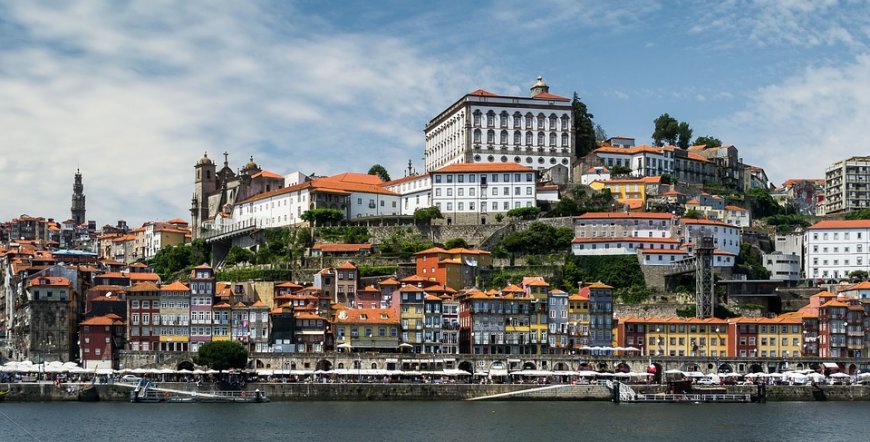
Porto is a city in northwestern Portugal, located on the northern bank of the Douro River, near its confluence with the Atlantic Ocean. Its population is about 1 million with the agglomeration and it is the second largest city in Portugal after Lisbon. The name of the city dates back to the 5th century and the time of the Romans. It was originally named Portus Calais, meaning port of rocks, because of its location on the rocky river bank. Gradually, this area grew into an independent kingdom called Portuscale and later replaced by Portugal - so the name of the country comes from the name of the city Porto.
Porto is an interesting city, especially its combination of old and new. If one walks through the old part, especially around the coastal district of Ribeira, one is immersed in the history and sights left over from more than a millennium ago. The narrow and steep cobbled streets take you to a world so far away, where people loved beauty. On most of the houses, the facades are covered with the famous azulejo tiles, in different colors, which gives a special charm to the setting in the old town. It is not by chance that the Ribeira neighborhood was declared a World Heritage Site by UNESCO in 1996.
Sightseeings in the Ribeira neighborhood:
1. Ribeira Cathedral - The cathedral is situated on a rocky hillside. It was built in the 12th century in the Romanesque style, but only the two twin canbanaries remain from that time. They are built of gray granite, the most interesting being the entrance with its statues and the beautiful flower rosette above them. The cathedral underwent significant changes in the 17th and 18th centuries. Entering inside, the visitor passes through a long corridor with columns on both sides or a nave, which is too modest. Therefore, attention is directed to the wonderful altar, created between the 17th and 19th centuries.
Here is the statue of St. Virgin of Vendome from the 14th century, placed in a gilded niche and is the embodiment of the Virgin Mary - the patron of the cathedral. And the main altar glitters with an even greater abundance of gold. Here, the frescoes of the Italian architect and artist Nazoni (1691-1773) arouse the admiration of visitors. Opening the door to the right of the nave, one sees the seven panels of azulejo tiles set in seven arched spaces, a true masterpiece of art. They date from 1731 and depict Solomon's Song of Songs and scenes from the life of St. Mother of God. In the governing body, which was additionally built (transept) in the 18th century, an exhibition of unique objects can be seen, such as richly decorated clothes, statues, silver crowns, azulejo tiles. The beautiful carved wood candlestick or candelabra is one of the most beautiful exhibits on display here.
In the chapel of St. John is placed the stone sarcophagus of Joao Gordo - the father of Enrique the Navigator, which is from the 14th century, and also the statue of St. Virgin of Batalya. The staircase to the upper gallery was designed by the Italian Nazoni.
2. The church "St. Francis" - Church "St. Francis" was begun in 1245 and when Dom Joao I and his wife Philippa came here in 1425, it was not yet finished. After the changes it underwent in the 17th and 18th centuries, the Church of St. Francis remains stunning with the richness of its decoration: its entire surface is covered with gilded carvings consisting of vines, cherubs and birds. Even today, the most impressive thing in the church is the altar, located to the left of the nave. Here the tree of Jesse is depicted in gilded wood, along with the 12 kings of Judah. They are located in the branches of this tree that grows from the body of Christ and ends with St. The Virgin and Child. Because they are the most important - without the Mother of God, there would be no Christ. This sculpture is the work of local artists Filipe de Silva and Antonio Gomes from the beginning of the 20th century. In the monastery opposite the church there is a small museum with an exhibition of icons and several catacombs.
3. The Palace of the Commodity Exchange Behind the church "St. Francis" rises the beautiful "Palacio da Bolsa". During a fire in the church, the stock exchange building was destroyed to the ground. In 1848, by order of Queen Maria II, construction began on a new building for the Porto Chamber of Commerce.
The architect was Joaquim da Costa Junior, and the funds for the construction came from the merchants themselves. The design of the palace was influenced by two hospitals in Porto, which have a very beautiful architectural layout. The halls throughout the building are very well furnished and decorated. The Hall of Nations is the most representative. Here the space is bounded by a huge dome of glass and metal, decorated with the national coats of arms of the countries that were Portugal's best trading partners in the 19th century, Great Britain and the United States. The floor is covered with a Greco-Roman style mosaic. The grand staircase in the Palace was designed by Adolfo Gonçalves de Souza in 1868. In the Portrait Hall, the table designed by cabinet-maker Ceferino José Pinto is something impressive. The relic of the Palace is the Arab Hall. Begun in 1862 by Adolfo de Souza, modeled on Alhambra, Spain, it took 18 years to complete. The beautiful ornaments look even more brilliant because of the wonderful light reflections.
Today, the Commodity Exchange Chamber is a national monument, which is visited by about 200,000 people a year.
Vote:
Rating 5 from 1 voted


