

Évora, Portugal
Situated on a low hilly terrain, Évora is a pearl in Portugal's historical treasury and an excellent example of Portuguese Golden Age architecture. This city-museum is located near the border with Spain, in the southern part of the country and belongs to the Alentejo region. Évora's urban landscape exhibits a unique blend of cultural influences that harken back to the Moorish, Spanish, ancient and medieval past over the centuries.
Alentejo is a region covering a third of Portugal's territory. The city of Évora is located in the center of this area, on a small hill surrounded by vineyards. With a population of about 50,000 people, it is the largest city in this area, and its historic center has been preserved in its original form.
The history of Evora begins 2 thousand years ago. The Romans called the settlement here Liberalitis Julia. Part of the walls of the premises of this settlement have been preserved. And the ruins of the monumental Imperial Temple of Diana claim to be the best-preserved Roman building in Portugal. The temple's fourteen Corinthian granite columns and their capitals of Estremuz marble are preserved in surprisingly good condition.
Later, Evora fell under the rule of the Visigoths, and in 715 it was conquered by the Moors. In the 12th century, the city became one of the most lively Portuguese cities, thanks to the Christian knight Geraldo Sempovar, who liberated it. The royal court often resides here and Évora has witnessed many royal weddings.
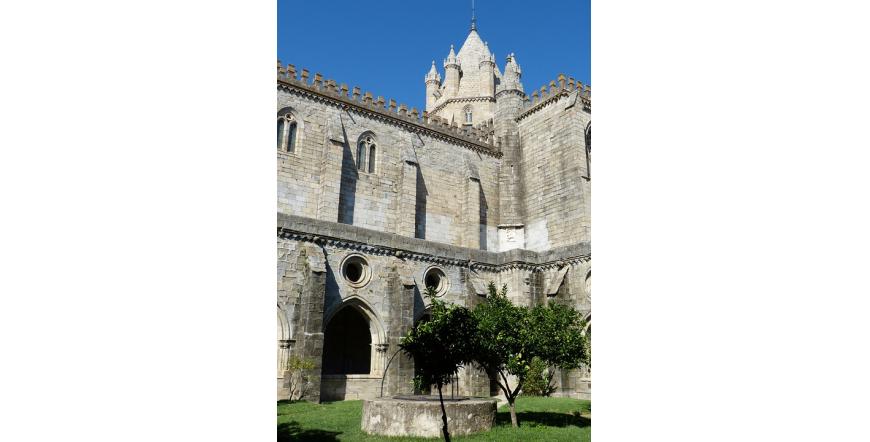
The cathedral, built in the 13th century, is the other landmark of Évora. The changes in the following centuries in different architectural styles add to its impressiveness. Vasco da Gama's pennants are said to have been lit here in 1497, before his flotilla set sail on its historic voyage. Inside the Cathedral, the vaulted gallery and treasury are must-sees. The magnificent 14th-century gallery houses the tombs of four archbishops, and spiral staircases in each corner lead to the top of the fortress wall, from where the view is magnificent. Statues, richly embroidered church vestments and other items belong to the treasury.
Close to the Cathedral is the Gothic Church of São João Evangelista from 1485, lined with azulejo tiles.
The local university is Évora's other landmark. It was founded by the Jesuits in 1551 and minds such as Clenardo and Molina taught here.
The Agua de Prata aqueduct, built in the 16th century for the city's water supply, has huge arches and is 9 km long. It is the work of the architect Francisco de Arruda, whose work is the Tower of Belem in Lisbon and many other architectural masterpieces in Portugal and Morocco. Today, at one end of the facility there are shops and cafes, as well as beautiful houses.
The Roman baths from the 1st century AD. can be observed through a glass wall in the City Council building in Praça de Sertorio square.
The 16th century episcopal palace houses the renovated Évora Museum, where you can see the triptych "The Passion of the Christ" (1510-1540) by Jean Penicot, the large expressive painting "The prophet Daniel frees the pious Susanna (1508-1512) and many others .
Between the Convento dos Loyuz Monastery and the private family church Igreja dos Loyuz, founded in 1805, the Public Library houses a valuable collection of documents related to the Portuguese Age of Discovery.
In fact, the city of Évora is the best preserved monument of the Portuguese "Golden Age". Around 4,000 interesting monuments from different historical eras can be seen within the old city - churches, palaces, gates and squares. That is why it has been declared a World Cultural Heritage monument by UNESCO.
Surroundings of Evora:
1. Cromlech "Almendres" - The magical cromlech "Almendres", formed by ninety-five stone blocks (menhirs), is located 16 km from the city of Evora. It is located on the slope of an oak-covered hill, after the village of Guadalupe. In all probability, ritual prayers and gatherings took place in this sacred place. The setting here is
extremely impressive, and the view of the city of Évora is impressive.
2. Escoural Cave - Escoural Cave is located near the Almendres cromlech. Cave paintings of animals date from 18 to 13 thousand years BC.
3. The Dolmen of Zambujeiro - The Dolmen of Zambujeiro is 6 m long and is the largest prehistoric monument in Iberia. It is located near the village of Valverde, in the area of the city of Evora.
4. Montemor-o-Novo - The town of Montemor-o-Novo is located near the megaliths of Almendres. From the ruins of the huge 13th-15th century citadel on top of the hill, you can tell that life was once bustling here. Historical data indicate that in the palace, located near the Citadel, decisions were made about voyages to discover new worlds, the construction of the University of Coimbra, and others.
After the 16th century, the population moved to the foot of the hill and thus the "new" town was created. From the Citadel, which has been partially restored, the panoramic view is very beautiful.
5. Down in the town, the church "Igreja Matriz" is of interest. The remarkable thing about it is that, together with the neighboring monastery from the 17th century, they were built on the birthplace of St. John of God (1495-1550) – Franciscan who founded the order of the Hospitaller brothers. His statue is located in front of the church. There is an annex to the monastery, where exhibitions of young artists are presented.
6. Evoramonte - Evoramonte is a village located 30 km from Evora, which arose around a castle with an interesting architectural layout, on the site of the castle of Dom Dinis I, destroyed in an earthquake. The castle is the work of the architect Diogo de Arruda, it was built in 1531 and imitates the French Chambord. The sturdy columns inside the castle are impressive, and the carved capitals are true works of art. A spiral staircase leads to the roof terrace, from where the view is amazing.
Vote:
Rating 5 from 1 voted


