

Belem, Portugal
Belem is an area in Lisbon located far from the city center. Its role is special because the Palacio de Belem presidential residence is located in the Belem area. Sights in the Belem area:
1. The Jeronimos Monastery - The magnificent Jeronimos Monastery is located at the bottom of the Prasa do Imperio monumental square. Its construction began in 1501. by order of Dom Manuel I. It was completed after a century and therefore the architectural and decorative elements are a combination of Gothic, Renaissance and Neoclassical forms. The monastery has political, civic and economic importance, as it is located near the coast where Vasco da Gama's ships docked on their return from India, as well as other expeditions.
The means to build this Manueline-style masterpiece came from the spice trade from the Indies and gold coming from Mozambique and Brazil. The monastery building survived the earthquake in Lisbon in 1755, thanks to the extraordinary architectural decision of the designers of this imposing and admirable building. Because of this, the monastery is included in the UNESCO World Heritage List. The south portal with its exquisitely carved stone sculptures is something impressive. They are the work of the Spanish artist Juan de Castilla.
Just above the door is the statue of Enrique the Navigator, to whom Portugal owes the realization of its overseas ambitions. At the top rises a cross of the Knights of Christ. The magnificent tombs of Vasco da Gama and the poet Louis Vache de Camois (1524-1580) are located next to the entrance under the gallery of the church choir. The tomb of the poet Fernando Pessoa (1888-1935) is in the vaulted gallery. In the main chapel is the tomb of Dom Manuel I, with the other four royal tombs supported by marble elephants.
The western portal with statues by the famous French sculptor Nicolas de Chantrain is noteworthy. Entering the monastery, the visitor stops in amazement in front of the vaulted gallery, whose arches and columns look like stone drapery. They are the work of the French architect Diogo de Boitaca. After his death in 1517, the Spaniard Juan de Castilla completed the second floor in 1544. In the monastery refectory, the 18th century colored azulejo tiles depict the life of St. Joseph, and the staircase leading to the choir is very interesting.
There are two museums in the modern wing of the monastery. A Roman statue of Apollo from the 2nd century, found in the Algarve, is on display in the National Archaeological Museum, and also the granite boars and warriors of the Douro region. There is also a Treasure Hall where interesting exhibits are displayed. Boats and barges, ship models, navigational instruments, naval uniforms and more can be seen at the Maritime Museum. The most interesting exhibit here is the seaplane with which Gago Coutinho and Sacadura Cabral flew from Lisbon to Rio de Janeiro in 1922.
2. National Palace "Ajuda" - National Palace "Ajuda" is located on the hill behind the monastery complex. The furnishings, painted ceilings, statues and tapestries are attributed to King Louis and his Italian wife Maria Pia, and also to their son Carlos I. He was an excellent painter, as the Neo-Gothic painting studio in the palace, furnished with simple wooden furniture, speaks of. More than King Carlos I's paintings are on display at the Villa Visoza Palace in Alentejo.
3. Belem Cultural Center - The Belem Cultural Center is a modern building with an interesting geometric shape, designed by the Italian Vittorio Gregotti and the Portuguese Manuel Salgado. It was opened in 1999. A monumental main staircase leads to the halls of the Cultural Center. Of interest is the Berardou museum collection, containing over 800 works by famous artists from 1900 to the present day, such as Miró, Picasso and Warhol. The museum also houses the private collection of modern contemporary art of José Berardo. Temporary exhibitions are organized in the halls of the Cultural Center. Many well-arranged shops and cafes are located around it. Belem Docks Belem Docks can be reached from the Cultural Center via a pedestrian underpass under the coastal boulevards. The Monument to the Discoveries is the biggest landmark here. It was built in 1960 and is dedicated to the Portuguese discoveries. It represents the bow of a ship facing the Tagus River, on both sides of which are sculpted sculptures of historical figures. At the very front of the ship's bow is the figure of Enrique the Navigator, to whom we owe the transoceanic Portuguese discoveries. On the sidewalk, at the foot of the monument, a huge compass containing the world map has been made with colorful tiles.
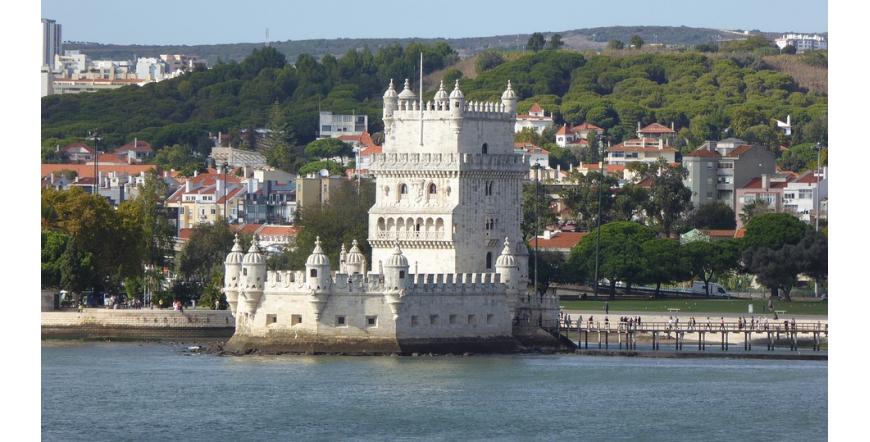
4. The Belem Tower - The Belem Tower is an architectural jewel and a symbol of the Portuguese capital, Lisbon. It is located on the northern bank of the Tagus River and originally stood on an island in the river.
After the earthquake in 1755, the river changed its course and since then the fortification has been attached to the shore. Built in the period 1515-1521 in the Gothic and Manueline styles, which fit perfectly into this remarkable architectural masterpiece. King Dom Manuel I (1495-1521) wanted this fortress to be a solemn gateway to the world, in addition to being a defensive facility with visibility in all four directions.
The project and construction were the work of the brothers Francisco and Diogo de Arruda. The windows facing the river have beautiful visors made in the Venetian style. The battlements are unique in their shape of shields, decorated with the cross of the Order of Christ. The beautiful terrace with the figure of St. Vincent seems to be designed to send and welcome sailors on their long journey to discover new countries. The loggias of the tower itself are vaulted and with beautiful stone parapets, and the view from them is indescribable.
5. Coach Museum - The collection of carriages at the Belem Coach Museum is considered one of the best in the world. The carriages are from the 18th and 19th centuries and are unique in their craftsmanship.
6. The Confectionery - As the end of the journey through the Belem area, people must visit the famous Confectionery in Lisbon, located on the side of the Jerónimos Monastery. It is a labyrinth-like room dating back to the 19th century. The famous custard cakes, prepared by the monks in the neighboring monastery, were served here. The walls of the pastry shop are covered with azulejo tiles and their gorgeous colors create a pleasant mood.
That is why even now the famous pastry shop is visited not only by tourists, but also by many Lisbon families who enjoy the delicious pastries served here.
Vote:
Rating 5 from 1 voted


