

Estoril, Portugal
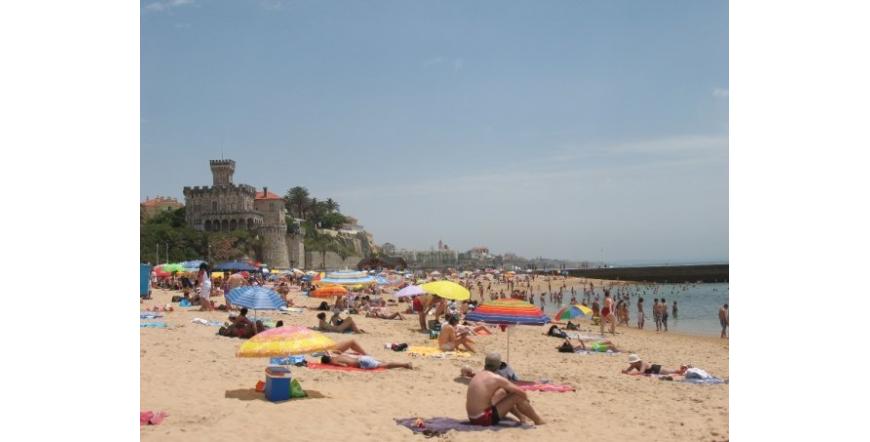
Estoril is a small Portuguese town located in the municipality of Cascais, Extremadura region, on Cape Cabo da Roca, which is the westernmost point of continental Europe. Estoril's very location on the ocean and only 20 km from the capital Lisbon, make it a good destination for rest and relaxation, even on weekends. The Cape de Cabo da Roca lighthouse from 1846 is remarkable, emitting a light that can be seen from a distance of 42 km. The lighthouse is located on a cliff 140 m high. The views from here are fantastic, and a cross on the cliff end indicates the location of the westernmost point. There are not many historical sites in Estoril, but there is still plenty to see. The top floor of the post office, built in 1942, houses the Estoril Exiles Museum and here one can learn something of the town's history. A great place for entertainment in Estoril is the largest casino in Europe, set in a lovely garden that reaches down to the oceanfront.
There is also a castle on the waterfront with a massive stone block structure built in 1917 by George O'Neill. The jagged towers the rich surrounding vegetation and the beach are a wonderful sight. In 1942, the castle was bought by Manteau Belliard, who turned it into a performance venue for artists and musicians. After his death , the castle became the property of Cascais Council and now houses the regional history museum, where concerts, temporary exhibitions and other cultural events are organized.
The beautiful houses, the wide beach, the tranquility and the variety of specialties in the restaurants here are the things that attract visitors to Estoril.
The coastline to the west of Estoril is dotted with hotels, restaurants and beautiful housing estates, and bypassing Cape Cabo da Roca leads to the Sintra Cascais Natural Park. To the north of the cape are a number of wonderful beaches. So spending time here can be an interesting adventure.
Cascais is a town almost adjacent to Estoril. Fully rebuilt after the great earthquake of 1755, the town became a favorite haunt of King Louis I and he built a residence in the citadel of the fortress in 1870. Since then, the royal family has spent the summer months in Cascais. The Citadel itself dates back to the 16th century, and the fortress is situated on a cliff jutting out into the bay and is one of seven forts used to protect Lisbon from attack. It now houses fashionable restaurants. The fishing port at the foot of the fortress has an eight hundred year tradition. Fishermen still take their catch out here every morning. From this period are also the large representative houses up on the hill, where the aristocracy enjoyed the fantastic views. Even now, in the old part of town, on the cobbled streets, in the attractive restaurants and fashion boutiques, you can feel the sophisticated taste of the rich.
Along the waterfront boulevard is the Castru-Gimaraes Museum of the Counts, housed in a representative 19th-century house. Cascais's most visited landmark is the narrow gorge of the "Mouth of Hell", where the sea waves pass with a roar through it. The incredible works of the Cascais-born artist Paula Regou can be seen in the House of the Stories of Paula Regou.
The ice cream of the legendary Santini Ice Cream House in Cascais is a must-try. The ice cream café is also a favorite spot of the Italian royal family when in exile here. Established in the 1940s, it is still one of the most visited places in town.
The National Palace of Keluz is located between Cascais and Lisbon. The main building is a country house that greatly appealed to Prince Pedro (1717-1786), brother of King José. At his insistence, the French architect Jean-Baptiste Robillon, transformed it into a miniature Versailles. The palace has 22 rooms, each furnished and decorated differently. Here one can see not only Portuguese furniture of the period, but also carpets from Arraiolos, jewels and many astonishingly beautiful types of porcelain. In the throne room, the glossy parquet floor and mirror-covered walls reflect the splendor of the poolei and gilded ceilings. In the so-called Don Quixote Hall, paintings on the walls depict scenes from Cervantes' novel. In this hall, Dom Pedro IV died. The gardens to the palace were again designed by Robillon, but also with the assistance of the French designer Le Notre. Many of the statues, ponds and fountains in the gardens have been preserved. Mostly used during the summer months, the Queluz Palace was used for bullfights, horse races, concerts and fireworks. Queen Maria I, Pedro's wife, lived here for many years. The royal family moved here for a few years after a fire at the Ajuda Palace in Lisbon. After the escape of the royal family to Brazil, the Palace of Quelus was rarely inhabited. Restored in all its glory, it now arouses the admiration of visitors.
In the surroundings of Estoril is the Sintra-Cascais Natural Park. As an extension of this beautiful park with pine forests, are a number of popular beaches. Ginxo is the beach where the European Windsurfing Championships are held. The beaches of Adraga and Grande, can be reached from the village of Almosajeme. From Grande, footprints resembling dinosaur footprints can be seen in the high cliffs. The beach of Añejas do Mar is the most beautiful, as the houses seem to be perched on the rocks, and a winding path leads to the ocean shore. There are also nice little restaurants to relax in.
Ericeira is a famous little resort, with a fishing harbor and an ancient center around the church on top of the cliffs.
The area around Estoril and Cape Cabo da Roca is mostly visited by Lisboners on weekends. The many restaurants open around the clock provide a pleasant atmosphere and their entertainment.
Vote:
Rating 3 from 2 voted


