

Cape Kaliakra, Bulgaria
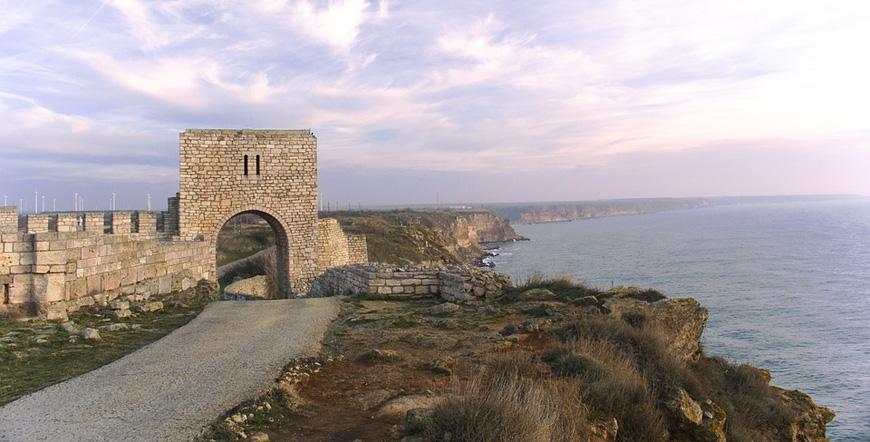
Cape Kaliakra is located on the Bulgarian northern Black Sea coast in the southeastern part of the Dobrudzha plateau and is very close to the villages of Bulgarevo and Sveti Nikola, 12 km from Kavarna and 70 km from Varna. Cape Kaliakra is associated with the legends of hidden riches in the caves and of the 40 beautiful maidens who braided their hair and threw themselves into the sea in order not to become Turks. The peninsula, 2 km into the sea, is attractive to many tourists and treasure hunters, who are looking for their dream wealth and hope to find it, and the obelisk at the beginning of the cape "The Gate of the 40 Maidens" is a symbol of the bravery of the Bulgarian, who defended your freedom.
The sheer 70-meter cliffs of Cape Kaliakra descend to the sea, and their reddish color comes from the iron oxide contained in their composition. Stormy waves have carved into the foot of the rocks bizarre caves, niches, niches and arches that can only be reached from the sea. The most ancient inhabitants of the Bulgarian lands, the Thracians, appreciated the advantages of the peninsula and only a short wall on the land side could protect a vast territory.
The first fortress was called Tirisis, after the tribe that inhabited these lands-Tirisis. And the bay formed by the cape was a wonderful refuge for the ships passing through here later during a storm. That is why the cape is called "Kaliakra", which means "Good Cape" in Greek. It is assumed that its name was given by the ancient Greeks in the 7th century BC, when their navigation in the Black Sea began. The barbarian invasions necessitated the construction of two more fortress walls and an increase in the population, as an outer and an inner city had already been distinguished. Some of them can be seen as a restored part of the fortress wall.
The heyday of Kaliakra came in the 13th century, when trade began with the export of grain to the Italian maritime republics of Venice and Genoa, and very soon the sea fortress of Kaliakra was indicated on Italian sea charts with a red sign for large administrative settlements. In the middle of the 14th century, Kaliakra became the center of a region of the Bulgarian kingdom called Karvun principality under the rule of the despots Balik and Dobrotitsa. With the ingenuity of good rulers, they were the first to start building a Bulgarian navy. Dobrotitsa galleys participated in successful combat operations in the Black Sea at Mavrokastro, Midia and Trapezuid. Written records speak of the existence of a powerful medieval settlement in which the ruler minted coins and turned Kaliakra into a church center. In 1393-1394, the Karvun principality was one of the last to fall under Ottoman rule. It is not by chance that the Dobruja region bears the name of this influential and progressive ruler.
Several historical events are associated with Cape Kaliakra. In 1444, the knights of King Vladislav III stopped here in his campaign against the Ottoman Empire. And on July 31, 1791, off the coast of Kaliakra, the great battle broke out between the Russian squadron of Admiral Fyodor Ushakov and the superior Turkish armada of Hussein Pasha. The bas-relief of Admiral Ushakov reminds of this battle.
On the top of the cliffs of Cape Kaliakra there is a small chapel with a wonderful view of the sea, related to the legend of the patron saint of sailors Saint Nicholas, who fled from the Turks, and God lengthened the earth under his feet, but was captured exactly where the chapel is now.
Due to its excellent location, Cape Kaliakra plays an important role in ship navigation on the Black Sea, which is mentioned as early as the 13th century. And during the period of Ottoman rule, there was a lighthouse on Kaliakra from 1856. Today, the new round tower with a height of 9.7 m shines with its white light and helps vessels in their sea journey.
Since August 2006, Cape Kaliakra has been equipped with a system of artistic lighting, consisting of over 100 colored spotlights, turning the cape, the sea and the surrounding area into an indescribable nighttime attraction.
Cape Kaliakra was declared a nature reserve back in 1941 and is the only one including a protected marine water area. Rare steppe plants are found here, and in the water you can see playing dolphins, Aristotelian cormorants, blackbirds, puffins, thick-billed larks, black-backed sandpipers, etc.
After the long walk around this amazing place, visitors can stay in the cave restaurant with 160 seats inside and about 200- outdoors. The service is excellent, and the unique view is worth coming here. A smaller cave houses a museum with archaeological exhibits and documents detailing the history of this extraordinary Cape Kaliakra. Since it is part of the 100 national historical sites, the seal of the Bulgarian Tourist Union is also located in the museum.
Very close to Cape Kaliakra is a small village called Topola with a wonderful view of the sea, the bay and the bizarre rocks. In this charming place, holiday complexes have been built, offering all the comforts for a holiday, together with a small beach. And for golf lovers, there is a huge golf course a few kilometers from Cape Kaliakra.
Vote:
Rating 5 from 1 voted
More sights in


