

Nessebar, Bulgaria
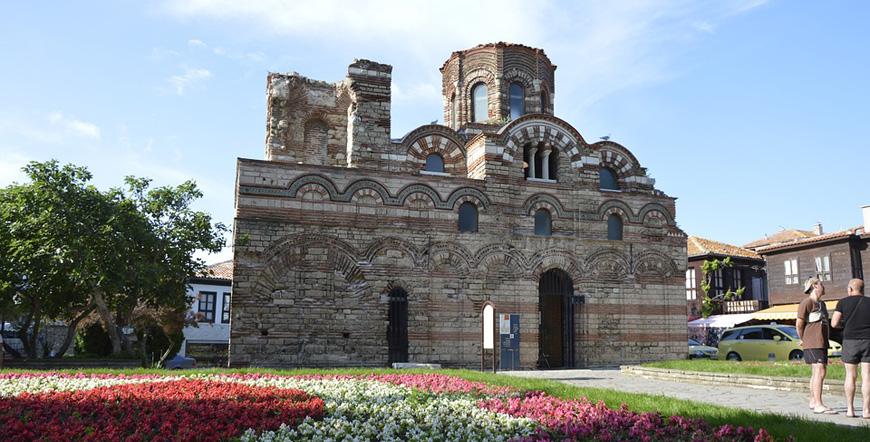
Nessebar is located in the south-eastern part of Bulgaria on the coast of the Black Sea. It is an awe-inspiring city, especially with its old part. Old Nessebar is among the ancient cities of Europe, founded more than 3 thousand years ago. Every cobblestone street, every old house, even the ruins are a story of the past greatness of an incredible city. Located on a small peninsula on the Black Sea, between the cities of Varna and Burgas, Old Nessebar is connected to the new part of the city by a narrow 400 m long isthmus. In the middle of it stands the old windmill, left over from Turkish times. Preserved in its authentic appearance, with the massive staircase to the second floor and the wonderful view of the sea, the windmill is a favorite place for the residents and guests of the city.
The city was founded by the Thracians, who named the settlement Menabria after its founder, Mena. The Dorians, who came in the 6th century BC. it was called Messambria and it became a well-fortified city-state with natural defenses from sea and land. A water network, a fortress wall, an amphitheater and numerous temples were built, the largest of which was that of Apollo. The city emerged as a commercial center, importing goods from all over the Aegean and Mediterranean regions.
Coins have been minted in the city since the 5th century BC. The Romans gave the settlement the name Mesemvria, and later it was called Nessebar. For the first time, Mesemvria became a Bulgarian city in 705, according to the agreement of Khan Tervel and Justinian II. The port of the city was Bulgaria's main commercial gateway to the world. Later captured by Byzantium, the city was his property until 812, when it was captured by the Bulgarian Khan Krum and was re-incorporated into the territory of Bulgaria. In the following years, the city passed many times from Bulgarian to Byzantine hands and vice versa. Nessebar achieved its greatest prosperity during the reign of Tsar Ivan Alexander, when most of Nessebar's churches were built, making the city unique to this day.
In 1336, the knights of Amadeus of Savoy captured and looted Nessebar, and then sold it for 15 thousand gold ducats to Byzantium. In 1453, shortly after Constantinople fell to the Turks, the city was captured by the Ottoman Empire. Almost nothing remains of the former greatness of the city of Nessebar, and the Liberation found it as an ordinary fishing village. Gradually recovering, Old Nessebar became one of the biggest tourist destinations in Bulgaria with its interesting architectural monuments, which still carry the romantic spirit of old Mesemvria. Thousands of pilgrims and tourists come here every year. Old Nessebar is included among the hundred national tourist sites of Bulgaria, and since 1983 it has been included in the UNESCO cultural heritage sites.
For such a small area of Old Nessebar - 850 by 350 m, there are too many cultural and historical monuments. About 42 churches have been discovered by archaeologists, but only one is active - "St. Virgin" from 1873. The other more preserved churches house art galleries and temporary exhibitions.
The church "St. Ascension of Christ" or "St. Spas" is the only one of the Orthodox churches in Nessebar, built during the Turkish slavery in 1609. Built of stone and mud, with a wooden roof, without a bell tower and dome, with small windows, part of the facade of the church is half buried in the ground. But the modest temple impresses with the frescoes painted by Nessebar painters. In this church, for many years, the gravestone of the Byzantine princess Mataisa Kantakuzina Paleologina, buried in the courtyard of the church "St. Sofia" in Nessebar.
The church "St. Sofia" or the Old Metropolis is part of the Architectural-Historical Reserve in the center of Old Nessebar. Built in the 5th century, it was richly painted, and its floor was decorated with colorful mosaics. Today, part of it has been restored so that visitors can see what the Basilica was like.
The church "St. Stephen" or the New Metropolis dates from the 11th-13th centuries and is one of the rare monuments in our country with well-preserved frescoes from the 16th century. All painted scenes in the church are thematically related to the Mother of God. The over a thousand figures depicted are collected in 258 compositions. Some of the scenes bear the names: "The Virgin with the Christ Child on a throne", "Assumption of the Virgin", "Introduction of the Virgin into the temple". And the big "Doomsday" stage is from the beginning of the 18th century. A painted wooden iconostasis from the end of the 16th century has been preserved in the church - one of the earliest preserved ones in Bulgaria.
The Ethnographic Museum is an important landmark in Old Nessebar. It is located in the house of the wealthy Greek merchant Panayot Moskoyani and was built in 1840. It is a Renaissance two-story house, a typical representative of Nessebar residential architecture. The upper floor has numerous windows, overlooking the sea. And the ceiling of the salon is decorated with a wonderful star-shaped rosette.
In the Archaeological Museum of Old Nessebar, a valuable treasure weighing 200 grams, dating from the 3rd century BC, is stored. The diadem, bracelets, and head and foot ornaments belonged to a woman of high social status who was buried with them. And the treasure from the Middle Ages, discovered on the peninsula in 1958, is kept in the National Archaeological Museum. In one of the halls of the museum you can see the valuable inscription discovered during excavations - Decree from the end of the 4th century BC in honor of the Thracian chief Sadala, who is supposed to be of the line of Seutus III.
The amphitheater near the seashore tells about the life that boiled in this beautiful, green ancient city.
And as an addition to the extraordinary atmosphere of the Old Town, there is the Fisherman's monument from 2006. Already at the beginning of Old Nessebar stands the statue of a fisherman in a boat, holding a cross and a dove in his raised hands. The 10-meter-high statue visible from afar is the work of the sculptor Stavri Kalinov and symbolizes the new Noah in search of the Promised Land, and the dove - that he found salvation on the Nessebar coast.
Today Nessebar is a preferred resort with rest stations, hotels and modern facilities for entertainment and tourism.
Vote:
Rating 5 from 1 voted
More sights in


