

Sofia, Bulgaria
Sofia is the capital of Bulgaria. It is located in the northwestern part of the country, at the foot of the Vitosha Mountain. The city was proclaimed the capital of the young independent state in 1879. There is a great desire of the entire people, their capital and their country to become beautiful and worthy rivals of European cities and states. From these boom years, they are a major part of the sights of Sofia.
The church "St. Sofia" and the museum under the basilica, in which there are about 50 tombs of different architecture, over 100 burial facilities from different periods and parts of ancient Roman mosaics.
Park-museum "Vrana" is one of the most unique on the Balkan Peninsula, created at the beginning of the 20th century by King Ferdinand. It was intended as a summer residence of the royal family.
The National History Museum is one of the largest on the Balkan Peninsula. It has over 650,000 objects of fine art, history, ethnography and archeology dating back 8,000 years.
Temple-monument Alexander Nevsky Cathedral is one of the most popular sights of Sofia. Built according to the project of the Russian architect Alexander Pomerantsev in (1843-1903), during holidays it can gather about 5 thousand people. The bell tower of the temple is majestic, which is 50 meters high and has 12 bells, the largest of which weighs 12 tons. In its crypt are exhibited the most valuable 200 masterpieces of Bulgarian icon painting.
Sofia University "St. Kliment Ohridski" is the first higher education institution in Bulgaria, established in 1925, with personal funds of the brothers Evlogi and Hristo Georgievi, whose statues adorn its main entrance.
Not far from Sofia University, in a beautiful park, is the tomb-monument of Alexander Battenberg, the first prince of the Third Bulgarian State. This modest, sophisticated building was designed by Swiss architect Hermann Mayer. In the tomb itself, there is a stone sarcophagus, a Battenberg bas-relief and memorial plaques with the names of the places where decisive battles took place during the Serbo-Bulgarian war.
Near the University is the National Library "St. St. Cyril and Methodius", which is the oldest cultural institute in post-liberation Bulgaria. Opened in 1953, it holds about 7.8 million library items. One of the most valuable books in its storage is the Welcome Gospel from the 13th century, which is a medieval Bulgarian written document, which contains 175 parchment leaves, and only 127 leaves of the Gospel are stored in the library.
The building of the National Assembly was built in 1884 in just a few months, being erected on the remains of the ancient necropolis of ancient Sofia. In the lobby of the beautiful building, the amazing Austrian chandelier weighing more than one ton makes an impression. The wooden banks of the deputies are unique, which are made of boiled beech and are assembled in whole rows using a special technology. The library of the building houses all shorthand diaries of the sessions of the Parliament from 1879 to the present day.
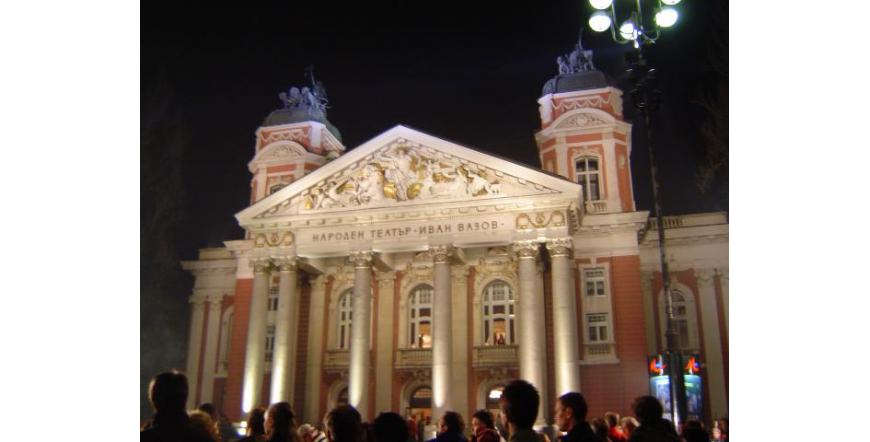
The building of the Ivan Vazov National Theater was designed by Viennese architects Hermann Helmer and Ferdinand Fellner and is one of the most beautiful in Sofia. The theater opened its doors for its first performance in 1905. The exterior architectural layout of the building is interesting. Columns with graceful capitals support a triangular roof over the theater entrance. Above the main roof tower two chariots with lions and the goddess Nike, a symbol of victory in artistic circles. They are made in Vienna and covered with five centimeters of zinc brocade. The picturesque layout of the ceiling, loggias, balconies and walls inside was done by the famous Viennese artist Rudolf Fuchs. The curtain of the stage, depicting the undying phoenix bird, is very beautiful, as is the theater. The curtain weighs 350 kg and is made by Bulgarian master carpet makers. The National Theater has a rich repertoire of contemporary and classical works.
The Lion Bridge is located in the central part of Sofia and was built over the Vladaya River in 1889 on the site of the old Sharen Bridge. The project and implementation are by Vaclav Proshek. The bridge is 26 m long, 18 m wide, with two openings of 10 m each. The remarkable thing about the bridge is the statues of four lions, located two on each side of the bridge. The bronze lions arrived from Vienna in July 1891, but all four are without languages. An interesting fact is that the famous French architect Gustave Eiffel, the creator of the Eiffel Tower in Paris, was invited for the construction of the bridge, but he did not agree to come to the new country. In 1930, an impressive arch was erected on the Lion Bridge for the ceremonial welcome of King Boris and Queen Joanna. The Boris garden is one of the treasures of Sofia. The creation of the park was the work of the Swiss Daniel Neff in 1882-1884, and the first plants were planted by him. The name of the park was given in honor of the birth of the heir to the throne Boris Turnovski. On the territory of the park there are two stadiums - "Vasil Levski" and "Bulgarian Army", the artificial lake Ariana, the beautiful lake with lilies and many other entertainment facilities for young and old.
The Presidency building is located in the center of Sofia. It was built in the period 1954-1956, according to the project of arch. Ivan Danchov. Here is the workplace of the president of the country and his team. This is one of the most massive and beautiful buildings in the capital of Bulgaria. Interestingly, in front of the main entrance of the Presidency there is a guard sentry that changes every round hour. The construction of the National Palace of Culture began in 1981 in honor of the 1300th anniversary of the establishment of the Bulgarian state, based on the idea of Lyudmila Zhivkova. It has 13 halls, the largest of which has 3380 seats. The entire interior of the National Palace of Culture is represented by a bird entwined in the rays of the sun, symbolizing the flight to knowledge and light. NDK is an institution that has hosted world-famous ballets such as that of the Bolshoi Theater, famous conductors such as Herbert von Karajan, world-famous performers such as Andrea Bocelli, Jose Carreras, Nikolay Gyaurov, Gena Dimitrova and many others. etc.
The former royal palace was built after the Liberation of Bulgaria from Ottoman rule. The newly arrived Prince Alexander Battenberg commissioned the Viennese architect Viktor Ruppelmeier to design a new building, on the site of the former Turkish inn. The able architect skillfully used the foundation of the inn and part of the main facade and built a modern and stylish building to be the prince's palace. After September 9, 1944, the palace was turned into the seat of the Council of Ministers, and today it houses the National Art Gallery. Unfortunately, nothing remains of the palace's original furnishings except for a fireplace and a few mirrors.
Vote:
Rating 5 from 1 voted
More sights in


Weather in Sofia, Bulgaria

26.53 °C
Wind: 1.03 m/s
Humidity: 36 %
Pressure: 1019 hpa
Clouds: 0 %
Wind: 1.03 m/s
Humidity: 36 %
Pressure: 1019 hpa
Clouds: 0 %