

Shkodra, Albania
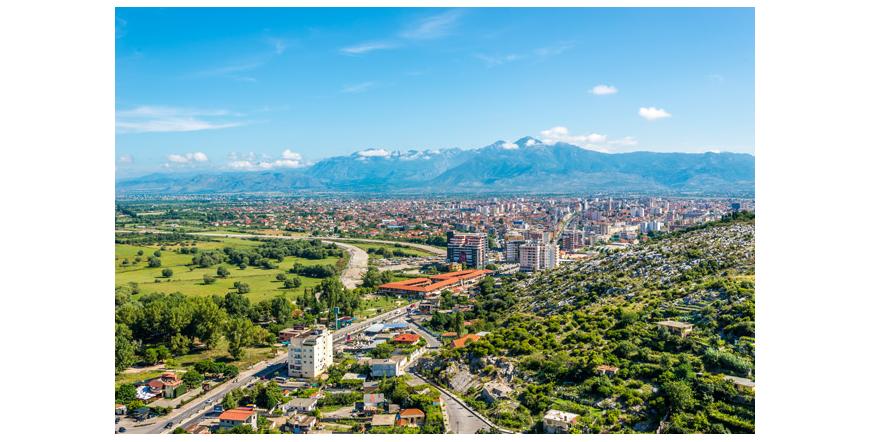
About 86 km from Tirana, in the delta of the Drina River, along Lake Shkodra, on the southern side of the Mbiskodra Plain and between the Drina and Boyana Rivers, is another famous town in Albania - Shkodra, also known as Skadar. The town is geographically located in northwestern Albania and belongs to the Shkodra region. Shkodra is an important cultural and economic centre, one of the oldest and most historic places on the Balkan Peninsula, as well as an important cultural and economic centre.
Through many different eras it has maintained its status as a major city due to its geostrategic location near the Adriatic Sea and Italian port cities, but also with overland routes to other points in neighbouring regions.
Shkodra is a city with a rich history dating back to the Bronze Age, 2000 to 3000 years ago to the present day. In the middle of the 3rd century BC it was the capital of the first kingdom of the Illyrian tribe of Ardiai, which settled on the Adriatic coast. The city was first mentioned in antiquity as the place where the Illyrians minted coins. In 168 BC the city was bequeathed by the Romans and became an important trade and military route. Later the Romans colonised the city. Shkodra remained in the province of Illyricum , and later in Dalmatia . In 395 AD, the city of Skopje became the capital of the Greeks. In 395 AD Shkodra became part of Dacia, within Pravellatana.
In the 15th century Shkodra stood out as the most important fortress of the Venetian Republic in Albania. In the spring of 1474, Ottoman troops launched a heavy invasion against the city, led by the Rumelian Beilerbey Suleiman Pasha, attacked the city. Although the Venetians and Ivan I Crnojevic, Prince of Zeta, tried to break the siege, it continued until the end of July, when the Ottomans withdrew.
Again in the same century, in the spring of 1478, Sultan Mehmed II himself led an Ottoman campaign to Shkodra. The siege of Shkodra began on 14 May 1478, and the sultan arrived near the city in early July. Several more unsuccessful Ottoman invasions were led against Shkodra in late July, after which Mehmed abandoned direct attacks. The city remained under siege by a contingent led by Evrenosoglu Ahmed. Exhausted by the prolonged war and facing a direct threat to its security, in early 1479. Venice made peace with Mehmed, ceding to him Lemnos and Shkodra, whose population was expelled and new settlers brought in their place.
At the outbreak of the Balkan War, the city was besieged without success by Montenegrin and Serbian troops, but remained under Ottoman control until the end of hostilities. Shkodra and the surrounding areas are blessed with a wide variety of natural and cultural elements. The most attractive parts of Shkodra are the city centre, located between the statues of Mother Teresa and Luigi Gurucuci and Gjahadol, and the area around one of the most picturesque streets connecting the Cathedral on the east side of the city with the city centre. The area's main landmark is the medieval fortress of Rosapha, whose battlemented towers overlook the lake, the city and the seafront to the south. Locals will also point you to the Marubi Museum of old photographs taken at the turn of the century. There are numerous ancient churches and mosques. Shkodra is one of the few towns to be connected by rail.
Undoubtedly the most recognizable landmark is the legendary Rozafa Castle, also known as Rozafati or Shkodra Castle. This medieval fortress rising above Shkodra is the city's greatest historical landmark. Rosapha is located 130 m above sea level and is naturally protected because it is surrounded by the Boyana and Drina rivers. There are assumptions that the site, due to its strategic defensive location, was fortified as early as the time of the Illyrians, who led the resistance against the Romans during the Illyrian Wars.
According to one legend, the fortress was built by three brothers. What they built during the day crumbled at night. One day the brothers met a wise old man who gave them valuable advice - to make a sacrifice. The brothers decided to bury something sweet and expensive in the building for the success of their common endeavor. This person would be the wife who brought them their first meal at the construction site the next day, and it was the youngest brother's wife named Rosapha (according to one version, the older brothers warned their wives to be late), from whom the fortress got its name.
Lake Shkodra is the largest lake in southern Europe and is a major summer attraction for tourists and residents.
Another interesting historical site are the ruins of Shirdha, a medieval town located just 15 kilometres from Shkodra. Shurdha was built on top of an island surrounded by the waters of the Drini River (which has now been diverted to form an artificial lake).
About 5 kilometres east of Shkodra is another landmark, the medieval fortress of Driht.
Many visitors consider Shkodra to be the soul of Albania. The characteristic appearance of the town consists of a combination of ancient houses and narrow streets connected by stone walls and modern buildings. After World War II Shkodra was rebuilt with wider streets to accommodate car traffic, and new residential buildings are continually being constructed.
Other popular landmarks include the Ebu Becker Mosque, Shkoder Cathedral, Shkoder Orthodox Cathedral, Kratul Church and Shirj Church.
Vote:
Rating 5 from 1 voted


