

Tirana, Albania
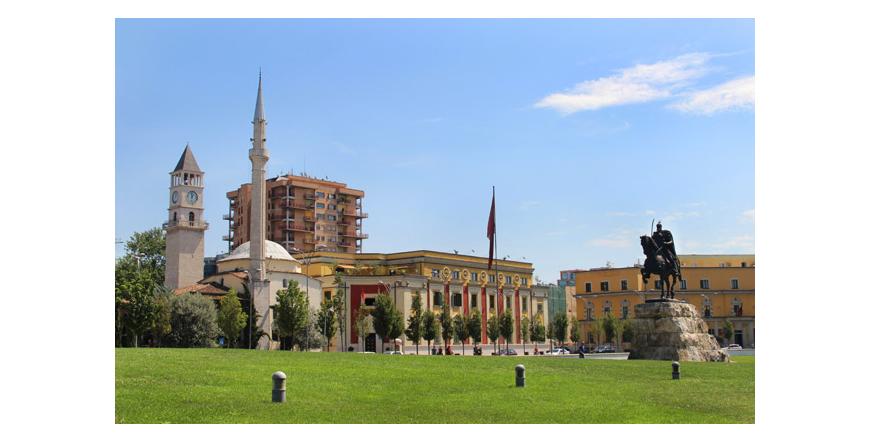
Tirana - the heart of Albania's cultural, economic and governmental activity. Tirana is the capital and largest city in Albania. The city is located in Tirana County, Tirana Region. Geographically, Tirana is situated on the Ishmi (Lana) River and like old Sofia has its own mountain, Daiti, at the foot of which it is picturesquely situated. The city is located in the western center of the country, beautifully surrounded by the hills of the Daiti Mountain to the east and the valley that opens to the northwest overlooking the Adriatic Sea in the distance. Tirana is about 700 km north of Athens, 290 km west of Skopje, 250 km southeast of Pristina and 160 km south of Podgorica.
As the capital and largest city, Tirana is Albania's main industrial and cultural center. In the city's economy, the most developed and important industries include agricultural products and machinery, textiles, pharmaceuticals, and metal products. Mother Teresa Airport is 14 km from Tirana. Tourism trends are now taking place in Tirana, although they are hampered by political instability in the region. The problematic political climate is due to the military conflicts in the 1990s in Albania and neighbouring Bosnia and Herzegovina, Kosovo and the Republic of Macedonia.
An interesting feature of the Albanian population is the fact that they are for the most part atheists. This is the result of the long communist rule of Enver Hoxha, a dictator who has kept Albania almost completely isolated from the world. Enver Hoxha even succeeded in breaking off initial friendly relations with the USSR and China. Everything in Albania under Enver Hoxha moved on the principle of 'more saintly than the Pope'. At his will, Albania even left the Warsaw Pact, for ideological reasons.
The Annals says that Tirana is a city with a rich history dating back to the Paleolithic period. The oldest settlement located in the area of the city is the Pellumbas Cave, located in the present-day village of Pellumbas. As various archaeologists claim, Tirana and its suburbs are filled with ancient Illyrian toponyms, as its surroundings are one of the earliest areas in Albania to have been inhabited. One of the ancient monuments in Tirana is part of an ancient Roman house from the 3rd century. Later, in the 5th and 6th centuries a Paleo-Christian basilica was built. Tirana's heritage from the classical period can be found in the city, where ancient monuments and works of art have been preserved. Tirana has also preserved Roman and Byzantine monuments as well as a number of Ottoman monuments. From a historical point of view, it must be said that the Albanian capital Tirana was founded in 1614, in the shadow of neighboring Kruja. Since 1913 it has been the capital of Tirana. Tirana received its official status as a municipality with the right to a mayor. From February 8, 1920, by virtue of a decision of a congress in Lushnja, Tirana was elected to the newly created - by virtue of a decision of the Great Powers - state of Albania, but the formalization of the decision itself was delayed - it happened on December 31, 1925. Tirana was elected the capital of Albania on March 27, 1921, replacing the previous one - Durres.
It can be said that Tirana does not have a rich catalogue of landmarks. Nevertheless, a day in the Albanian capital would be interesting for anyone. The city is modern and has the typical center of any Balkan capital. It is very important to note that the starting point of everything in Tirana is the central Skenderbey Square, where one of the main tourist attractions is located - the monument of Skenderbey The square underwent reconstruction in the twentieth century. Georgi Kastrioti Skenderbeg, for his part, is Albania's most famous national hero. He was a hostage of Sultan Murad II, but at the same time he fought on the side of the Ottoman Turks and against them. Eventually, after his reign, Albania was conquered by the Ottoman Empire in 10 years. But today, one thing Ottoman rule does not do is restrict women from wearing fedoras or headscarves.
Interesting sights in Tirana are also: - The Conciliar Orthodox Church; - The Opera House; - The Central Mosque of Ethem Bey; - The National Library; - The Clock Tower, which has been designated the symbol of the city - The ruins of the Justinian Fortress; - The International Cultural Centre; - The former Museum of Enver Hoxha; - The National History Museum; - The Zoo.
The typical Balkan center of Tirana is of course observed by cafes with outdoor tables and chairs, parks and fountains - an atmosphere charged with both tranquillity and dynamism. Among the pleasant restaurants with good cuisine are the "Rosafa" chain - pizza and seafood, Güvendia, the Bulgarian restaurant "Faitona" and one from the "Happy" chain of TIM. The National Opera and Ballet building in Tirana is an impressive building, part of the city's architectural heritage. Today it houses the National Library of Albania and the National Opera and Ballet. It can easily be called a cultural center.
The oldest building in the Albanian capital, the Etem Bey Mosque, was begun in 1789 and completed only in 1823. It tells the story of the city's Ottoman past, which grew from a village to a town during the reign of the enigmatic general Suleiman Pasha. The mosque in Tirana was built by Pasha's grandson and great-grandson, Molla Bey and Etem Bey. Haji Etem is credited with laying the foundations of the clock tower next to the mosque.
Inside the mosque itself is dotted with many beautiful paintings on the walls and ceiling. Since Islam forbids the depiction of humans and animals in mosques, the main motif is flowers and trees. The mosque has a separate floor for men and women.
We must pay attention to the Orthodox Cathedral of the Ascension. Its building is huge for the Albanian scale and brand new located in the very center of the city. Its glass "halo" around the main entrance glows a pleasant blue at night, and the bell tower is shaped like candles.
We'll also pass the History Museum, which has a large mosaic composition "The Albanians" on its facade, and their tourist information can be found behind the museum building.
Enver Hoxha's Pyramid, or to be more precise Enver Hoxha's Museum, is a building whose architectural design belongs to the daughter of the communist leader. The pyramid was a museum until 1991 and then became a convention center. During the Kosovo war, the pyramid also housed a NATO base. Unfortunately, nowadays the building is in a miserable state, there was an idea to demolish it, but after protests from the citizens they gave up, but they did not maintain it either.
A visit to the Zoo would be fun for all to see... about a dozen animals - lion, bears, eaglets, cats, rabbits, llamas, horse, buffalo, goats - all housed in 3 cages. Only the lion and bear have separate homes.
The night life is boiling in one neighborhood - In the former social quarter "Blok". Here, where in the time of Enver Hoxha the people were forbidden to enter, now are located almost all discos and cafes, and the streets are full of soaked babes, dressed in the latest fashions and made up like priests of the goddess of make-ups.
Vote:
Rating 4 from 1 voted


