

Rotorua, New Zealand
The city of Rotorua, with about 60,000 inhabitants, is located on the south shore of Lake Rotorua, in the Bay of Plenty region of New Zealand's North Island. The name of the bay was given by James Cook, one of the greatest seafarers of the 18th century, who, passing by here in 1769, noticed the abundance of food supplies in the several Maori villages. The closest towns to Rotorua are the picturesque towns of Tauranga - 60km away, Taupo - 80km away and Hamilton - 105km away. The distance from New Zealand's most populous city is 230 km. Rotorua became famous as a SPA-city thanks to Lake Rotorua, translated from Maori, meaning" two lakes".
Due to the geothermal activity around the lake, including still active geysers and hot mud pools, Lake Rotorua has a high sulphur content. This gives the lake's waters an unusual yellowish-green hue and distinctive smell. New Zealand's most active volcanic zone, responsible for many of the volcanic eruptions of 400,000 years ago, is now a maze of volcanic cones, collapsed craters, lakes and valleys overgrown with lush evergreen vegetation, offering fishing, beautiful scenery and ecotourism.
Here rises the volcanic mountain Tarauira. At its foot is the small thermal lake Rotomahana and its famous Pink and White Terraces. Their unprecedented beauty and healing properties made them a popular destination for balneotherapy in the 19th century, as well as a favorite place for artists and literary figures. The silicate formations of Lake Rotomakhana were declared one of the wonders of the world. But it all became Te Wairoa (The Buried Village) on 10 June 1886 when Mount Tarawira erupted. And just from the works of the artists and the works of the writers, one can guess about the magic of this place.
Even the local Maori understood and used the therapeutic benefits of the water in the hot pools. The beginning of the Polynesian Sanus Per Aqua-SPA, literally translated as "Health Through Water" was in 1878 when the Catholic priest Father Mahoney bathed regularly in the thermal waters of Lake Rotorua. After a few months his arthritis was relieved. Bathhouses and attached buildings began to be built and gradually Rotorua became a tourist resort. Some of the buildings are reminiscent of that distant time.
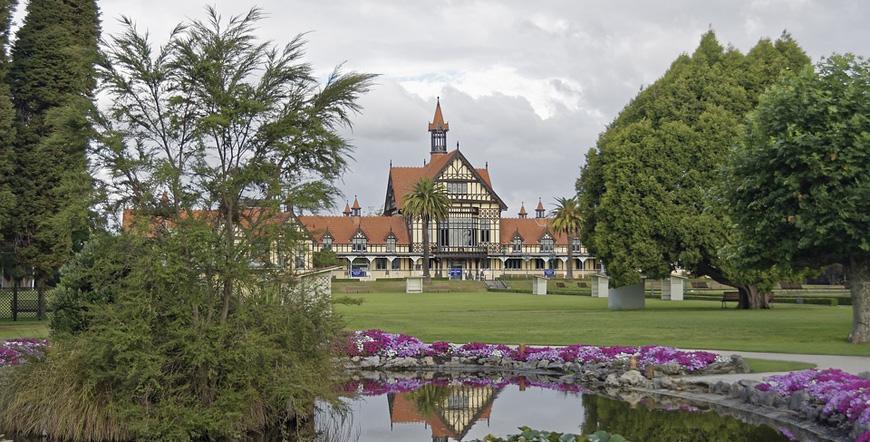
The first building, called Bath House, is the Museum of Rotorua and is a large building built in the Tudor style - a combination of stone, brick and wood in the exterior, specific pointed roofs and asymmetrical architecture. And the Blue Baths, in the Art Deco style, are still working today. In Kuirau Park at the west end of Rotorua, there are hot water pools where visitors can dip their feet and feel the magic of the healing water.
The Rotorua area contains 17 lakes, collectively known as the Rotorua Lakes. A common nickname for the town is the "Sulphur City", because of the hydrogen sulphide fumes . Many visitors refer to this place as "Roto-Vegas" because the strip of town surrounding the lakes is surrounded by hotels, bathhouses and restaurants and crowds of tourists, making it look like Las Vegas.
In addition to fishing and water skiing, Lake Rotorua is used for other events such as the 2007 World Aquatics Championships and the 2009 World Blind Sailing Championships. In the waters of the lake can land and take off sailplanes.
These days, the local Māori skillfully manage their heritage for the benefit of modern tourists, while also preserving their rich culture. New Zealand writer Alan Duff, born in Rotorua, tells of their lives in his book Once Were Warriiors.
Rotorua is on the one hand a reminder of the rich history of the Maori and on the other hand the incredible natural beauty of New Zealand.
Vote:
Rating 5 from 1 voted
