

Auckland, New Zealand
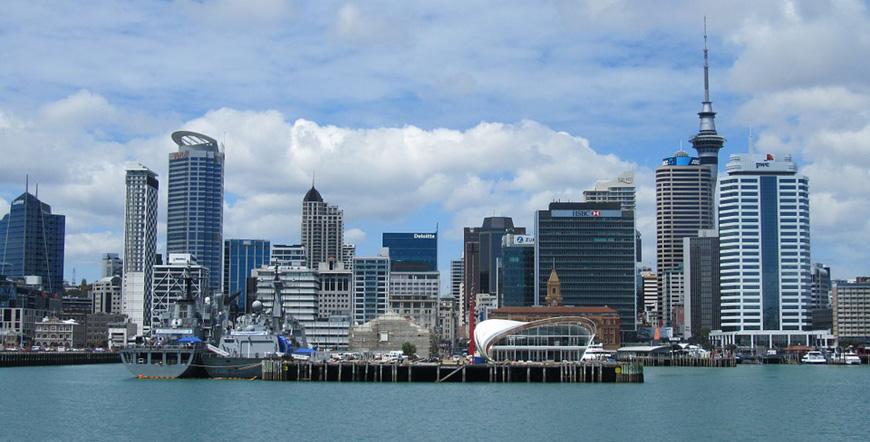
Auckland is a stunning New Zealand city, picturesquely situated on the western shore of the Pacific's Hauraki Gulf on the North Island. With a population of around 1.5 million, Auckland is a cosmopolitan city surrounded by a phenomenal water world dotted with more than 50 islands. In the Maori language, the city of Auckland is called Tamaki Makaurau, or "Place Desired by Many". Indeed, sun-drenched island entertainment, hikes through the jungle, a picnic atop a volcano, a tasting at one of the wineries or a stroll along the deserted ocean beach dotted with black sand-it's all a coveted dream or perhaps reality for this remarkable city. The extraordinary Polynesian culture combined with a passion for superb food and shopping draw tourists here from all over the world. Established in 1840, the city of Auckland was the capital of New Zealand until 1865 and takes its name from the English county of Auckland.
A tourist's tour usually starts from the central square, which in Auckland is called Aotea Square and is the venue for rallies, festivals and other public events. One of the most famous and impressive buildings in Auckland is that of the City Hall. Built in 1911, the five-story building holds a 1,673-seat concert hall and has some of the best acoustics in the world. The tower's large four-sided clock is an addition to this important city building, one of whose entrances is on Queen Street, the main shopping thoroughfare with a mix of old and new buildings.
Queen Street brings you to Wyemeta Harbor, where many yachts are moored, indicating that this is one of the preferred spots for yachtsmen-they also call Auckland the" City of Sails". And the volcanic island of Rangitoto protects Hauraki Gulf and the harbor from the winds that are commonplace on the ocean. The New Zealand Maritime Museum, located in Hobson Harbor, features exhibitions and displays relating to the country's maritime history.
Noteworthy is Albert Park in central Auckland with lots of flowers, greenery and a superb place to relax. Walking around the central part of the city, you will be impressed by the houses with arched terraces and interesting facades from 1897.
One of Auckland's important landmarks is the War Memorial Museum, located in a large public park on the highest point of the Auckland Domain. The huge fine building was constructed in the 1920s in neo-Gothic style. The museum's extensive collections tell the story of New Zealand's history. An antique cannon used in the wars greets you at the entrance, and one of the halls displays materials and exhibits from the wars and the indigenous Maori settlements. There is an interesting collection of historical maps, and also a small collection of significant maps relating to the discovery and exploration of the Pacific and islands by Europeans before 1800. The museum's collection of journals, from 1867 to the present, numbers some 4,500 titles; a museum herbarium of plant specimens; a large collection of snails; applied arts; furniture; jewelry; and musical instruments, including rare violins and an 18th-century harpsichord.
If you have more free time, and to delight the kids, you can visit the aquarium in the eastern suburb of Mission Bay, where you'll see penguins, turtles, sharks, tropical fish and other marine life.
Of Auckland's must-see attractions - the Museum of Transport, Rainbows Amusement Park with over 20 rides, St. John's Catholic Cathedral, the Auckland Museum of Transport , Patrick's Cathedral from the 19th century and the hall for 12 thousand people Spark Arena are not to be missed.
Auckland's iconic landmark is the Sky Tower-the tallest free-standing structure in the Southern Hemisphere at 328 meters with excellent panoramic views. The modern section of the Art Gallery is a huge unconventional building, completed in 2011, where artworks by New Zealand artists and masters of fine art can be seen. The twin towers of the National Bank Centre are among the tallest buildings in Auckland.
Auckland's other tourist destination is the volcanic cone with the grassy crater Maungahau in Mount Eden. This is the highest 196-metre natural point on the isthmus, from where the 360-degree view of the city is awe-inspiring. The majestic bowl-like crater is 50 metres deep and is named Te lpu a Mataaho (The Bowl of Mataaho). Mataaho, according to the Maori, is a deity who lives in the crater and is the keeper of the secrets hidden in the earth. Vehicles are forbidden to the summit. Curiously, the royal elephant, Tom, was involved in the construction of the observation platform on Mount Eden. The three-year-old elephant was a gift to Alfred, son of Queen Victoria, on his way to Auckland in 1870. Around the sides of the volcanic cone are basalt blue stones, which are used as building blocks.
Vehicles are prohibited up to the top. Curiously, the construction of the observation platform on Mount Eden, involved the royal elephant Tom. The three-year-old elephant was a gift to Alfred, son of Queen Victoria, on his way to Auckland in 1870. Around the sides of the volcanic cone are basalt blue stones, which are used as building blocks.
Much visited in Auckland is the Waitaker Regional Park, which is part of a mountain range of the same name. Notable in the park are the four surfing beaches of Piha, Wuriwae, Te Hengca and Karekare. Along the 77-kilometre Hilary Trail from Arataki Visitor Centre to Muriway through the mountain range, you will experience unforgettable moments enjoying the beautiful scenery and wonderful views found during the multi-day trek. It is no coincidence that the trail is named after the New Zealand mountaineer Edmund Hillary.
Many festivals are held in Auckland. One of the most interesting is the Fan Festival, when the streets of the city are abuzz with dancing, costumed fans of animals and other favourite characters.
The city's nightlife is concentrated along Queen Street, Ponsby Road and Carranghate Road. Auckland is one of the best cities in the world to live in!
Vote:
Rating 5 from 1 voted
