

Palace of Culture, Iasi (Romania)
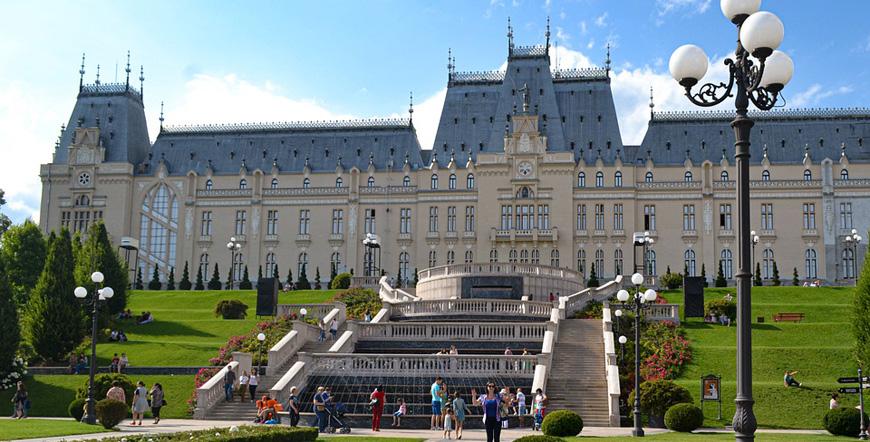
The Palace of Culture in the city of Iași, the cultural capital of Romania, is a huge magnificent building, the most important landmark of the city, gathering its interesting history. The palace existed since the reign of Prince Alexandru Morusi (1803-1806), which was later renovated according to the project of the architect Nicolae Singurov under Prince Mihail Sturja( 1841-1843). Situated amidst a huge park, the Princely Palace in the capital city of Iaşi, even then impressed with its massive size and opulence. From this period is the legend of the 365 rooms in the palace, as many days in a year.
At the beginning of the 20th century, the Romanian government commissioned the Romanian architect Berindei to design the restoration of the Old Princely Palace in the neo-Gothic style. Begun in 1906, the reconstruction was halted by the outbreak of the First World War, but although incomplete, the building housed Romanian and Russian soldiers. Repairs were completed in 1925 and the building was inaugurated by King Ferdinand I of Romania. But after the most complex restoration works of a historic building in Romania, which began in 1990 and was finally completed only in 2016, the Palace of Culture is a masterpiece, impressive with a stunning facade and interior.
Serving as the Palace of Administration and Justice until 1955, the Palace of Culture was renamed the Moldovan National Museum Complex. It includes four museums: Art, History, Ethnographic and Scientific. The equestrian statue of Stephen the Great (1433-1504), whose struggle for Moldova's independence is proverbial, is erected in front of the Palace's central entrance.
The main entrance to the palace is through the Great Tower, which is the main architectural part of the palace. On each of its three sides is mounted a clock with a diameter of 3.25 meters, the faces are decorated with stained glass representing the 12 astrological signs. Two young men in national costumes are painted on the sides of each of the clocks. And the song "Noga Unirii" on the 8 bells every hour, delights the inhabitants and guests of the city. The stained glass windows of the tower and the palace are illuminated in the evening, which adds mystery and enchantment to the whole building. The palace has 298 rooms covering an area of 34236 square meters, some of them decorated with a special material imitating oak wood.
In the 24 rooms of the Art Museum, one can see permanent exhibitions with works by world famous and Romanian artists such as Caravaggio, Paolo Veronese, Pietro Liberi, Salvator Rosa and many others. The Historical Museum offers more than 48 thousand exhibits of archaeology, numismatics, decorative arts, ancient books and other documents. One of the most interesting exhibits here is a mammoth skull 70 thousand years old, and also beautifully painted pottery from the Tripili culture from 4300-4000 BC. The Ethnographic Museum has more than 13 thousand objects related to the everyday life of the inhabitants of Moldova, as well as the interiors of rural houses and appliances used in pottery, weaving and woodworking. Curiously, most of the exhibits are more than 100 years old.
Amazing is the Gothic room in the museum, where medieval bestiary-painted animals such as griffins, eagles, lions, etc. arouse admiration. And in the Room of the Chiefs on the first floor is a unique door with metal decorative elements and here are exhibited the portraits of the rulers of Moldova and Romania starting from Decebalus and Trajan.
The view of the cascading fountain in the park adjacent to the palace and the many greenery and graceful benches are a nice place to rest after a wonderful walk in the Moldovan National Museum complex.
Vote:
Rating 5 from 1 voted
More sights in Romania


