

Tbilisi, Georgia
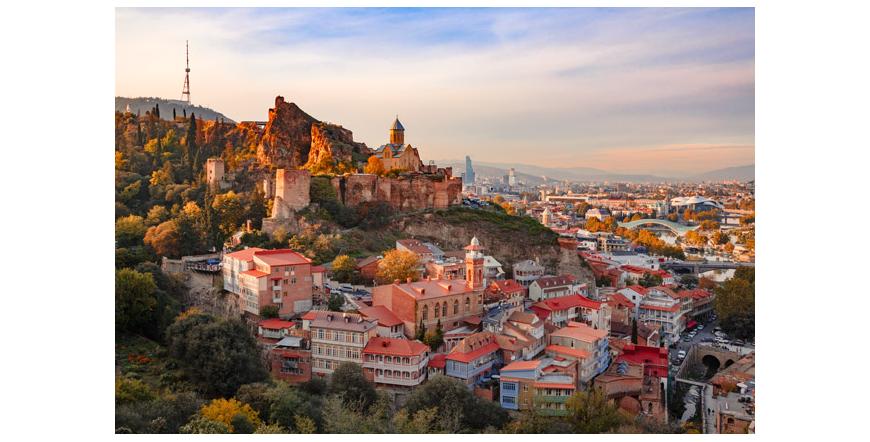
The capital and largest city of the small Caucasian country of Georgia is the city of Tbilisi. It is situated on both banks of the Kura River, in the Tbilisi valley, with an elevation of 400 m, situated between 380 m above sea level and 770 m above sea level. Tbilisi's diverse history is reflected in its architecture, which is a mix of medieval, classical, Middle Eastern, art nouveau, Stalinist and modernist structures.
Tbilisi is Georgia's most economically developed city and accounts for more than half of the country's GDP. According to Mercer's 2015 rankings, Tbilisi is the 10th cheapest city in the world. Due to its location at the crossroads between Europe and Asia and its proximity to lucrative east-west trade routes throughout history, Tbilisi has been a point of contention between various world powers. The city's location has so far ensured its position as an important transit route for various energy and trade projects.
Tbilisi was founded in the 5th century by Vakhtang I Gorgasali, the monarch of the Kingdom of Iberia, on the site of a small village that became the arena of a battle with the Persians in 368. A century later the capital was moved to Tbilisi from the city of Mtskheta. After the emergence of Islam and the rise of the Arabs, the city was captured in 645 and remained an Arab possession for 4 centuries. Tbilisi served as the capital of various Georgian kingdoms and republics, experiencing occupation by Persians, Arabs and Seljuks. The Arabs reigned in Tbilisi until 1122, when the city was captured by the Georgian king David IV the Builder, who decided and moved his capital from Kutaisi to Tbilisi. Tbilisi lived its "golden years". The inhabitants of the city began to produce weapons, jewelry, leather and silk. In 1235, the Mongols appeared on the scene of European history and the golden times ended. The "black years" for present-day Georgia began again and lasted until the 17th and 18th centuries. In 1795, Tbilisi was razed to the ground by the Persian Agha Mohammed Shah. Today there are almost no buildings from that time, the only ones that remain are located mainly at the foot of the Narikala fortress. In 1801, Tbilisi passed into the possession of Russia. After the collapse of Russia in the First World War, for a short period between 1918 and 1921. Tbilisi was the capital of independent Georgia, but in 1921 After the end of the civil war in Russia, Georgia became the center of the Georgian SSR. Since April 9, 1991, Tbilisi is again the capital of independent Georgia.
Georgians are extremely religious, with Orthodox Christianity being dominant. There are also Muslims and Jews in the city, but they are insignificant in number. In addition to numerous churches, a synagogue (dating from 1904) and a mosque (dating from 1895) can be found in Tbilisi, where Shia and Sunni Muslims find a place to pray.
Tbilisi is a city that has everything a capital should have - an ancient fortress, museums, ancient churches. From a tourist point of view, the city can be divided into old and new. In the old part you must visit the old quarter of Maidans, the church of Metekhi from the 11th century, the fortress of Narikala from the 4th century, one of the oldest fortified areas of the city, the Cathedral of Sioni (VI - VII centuries), the church of Anchiskhati from the VI century, and the quarter of Abatonutani, where the Turkish baths are located.
Architectural sights abound almost everywhere in Tbilisi. A large part of the catalogue of landmarks are the churches, which are extremely common and a distinctive feature everywhere in Georgia. The largest cathedral in the Caucasus, the Tsminda Sameba (Holy Trinity), is located here and was recently completed and opened to the faithful in 2004. The church is located in the eastern part of the city and was built with donations from ordinary people and with the money of Georgian businessmen.
Another architectural gem of Tbilisi is the historic district of Metekhi, which according to researchers is one of the oldest settlements in Tbilisi. Metekhi consisted of a church and a royal fortress built in the 12th century. Unfortunately, in 1235, during the Mongol invasion, these architectural monuments were destroyed.
Today's exquisite domed church in Metekhi was built between 1278 and 1284 by the will of the Georgian king St. Demetrius II, and the surrounding area was fortified in the 17th century. Today, the church and the old fortress walls in Metekhi are one of the most visited tourist destinations in Georgia. The ancient temple is built of stones and bricks and is architecturally greatly influenced by medieval architecture. The façade of the Meteki church is decorated with ornamentation, mainly centered around the windows. A bronze statue of the city's founder, Vakhtang Gorgasali, stands proudly in front of the temple.
The Narikala Fort, on the other hand, is the only and valid reason for one to climb the steep cobbled street. It offers a unique view - the winding Kura through the gorge, the pompous presidential palace, the countless old houses with tin roofs, the Turkish bath and the steaming marana.
The list of important sights and tourist sites of Tbilisi is quite large. To it we should add Sameba - the newest and largest cathedral, the monument of Vakhtang I - the ruler of Iberia and a national hero for Georgians, the buildings of the Parliament and the Supreme Court of Georgia. Not to miss the important cultural sites such as the National Museum of Georgia, the State Conservatory, the Opera House in Tbilisi, the Vorontsov Palace, many state museums, the National Public Library of the Parliament of Georgia, the National Bank of Georgia, the Peace Bridge and other important institutions. At the time of the Soviet Union, Tbilisi topped the list of cities with the largest number of museums.
In Tbilisi, the contrast is everywhere. A glance at the new part of the city shows the latest buildings, one is confronted with a new luxurious presidential palace, a massive cathedral and a pompous bridge to connect the past and a bright tomorrow. As night falls, evening hides the obsolete and Tbilisi shines in the bright highlights of well-lit landmarks. The new part of the city is a mix of glitzy streets, nightclubs, nice restaurants, branded shops. Life in Tbilisi carries the charge of past and present, reaching out its arms to the future.
Vote:
Rating 5 from 1 voted
More sights in Georgia