

Bojnice Castle, Slovakia
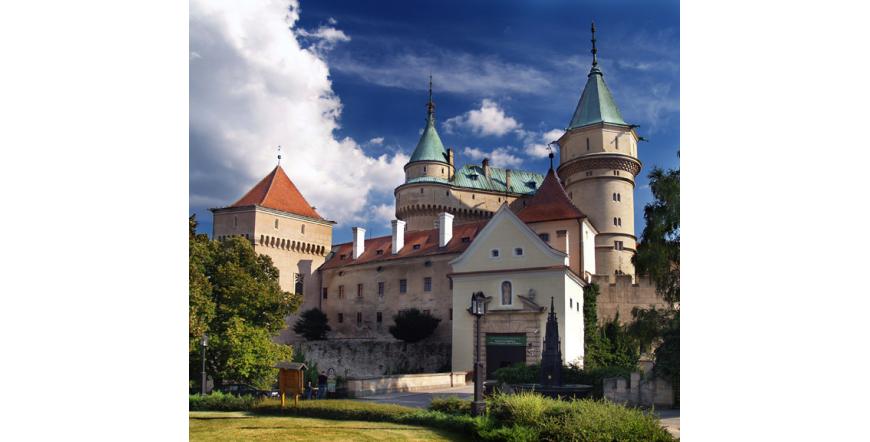
They say that the only places where magic really exists are in castles. It is there that the magic takes place, which passes through all the salons, halls and majestic bedrooms with a touch of royal life and an encounter with thousands of secrets, loves and stories that happened over the centuries. Slovakia is a country that is known as one of the most densely populated European countries with castles. Large and small, scattered on its hills, the palaces become one of its most impressive sights that adorn its lands. Their number exceeds 600. The palaces of Slovakia were built during different historical eras, the first of which date back to the 11th century. and their main role was to serve for the defense of the territory. Unfortunately, over the years, the castles have been rebuilt, some have been burned, others have been abandoned and collapsed. The surviving fortresses, castles and palaces are cultural monuments today. Among all of them, however, one stands out, which can undoubtedly be called the pearl in the country's crown - Bojnice Castle.
Bojnice Castle is located near the town of Bojnice in northwestern Slovakia. From a geographical point of view, it is located on a hill in the south-west corner of the city.
The first information about Bojnice Castle dates back to 1113. It was founded in the 12th century, originally in a medieval style, it was rebuilt in the style of neo-Gothic romanticism and was inspired by Italian and French architecture. Bojnice Castle became the property of many owners in the following centuries, it changed many owners, among them several kings of Hungary. Bojnice Castle was owned by the aristocratic Zapolski, Turzo and Palfi families. From the 17th century, Bojnice castle passed into the hands of the Palf family. The modern building was erected in 1889-1910 at the behest of Count János Ferenc Palf according to his own design, imitating the French castles in the Loire Valley. In his last will and testament, the last owner, Count Jan František Palfi, wished the castle to be accessible to the general public, which came true 42 years after his death.
Unfolding the history of Bojnice Castle in more detail, we should mention that its construction was originally a wooden fortification. This fortification was gradually replaced by a stone one, with the massive outer walls being shaped according to the unevenness of the rocky terrain. The first official owner of Bojnice Castle was the Hungarian oligarch Mate III, who received it in 1302 from the Hungarian King Władysław V. In the 15th century, Bojnice passed into the hands of Matthias Corvin, who in turn passed it on to his son John Corvin. Since then, a large linden tree, called "King Matthias's linden tree", grows in the castle yard. Under the thick shade of the linden tree, King Matthias dictated his official documents, which in most cases began in the same way - "Here under our beloved linden tree in Boinice...".
After the death of King Matthias Corvin, Bojnice Castle was registered as the property of the wealthiest family in the northern part of the Kingdom of Hungary - Zapolski. After major reconstruction of the old fortification, Bojnice Castle became a beautiful Renaissance castle. The mighty fortress walls and towers have been preserved to this day.
Over the centuries, the castle recorded several more new owners, each new one reconstructing it according to their vision of style and elegance, and in more recent times quite a few features characteristic of Renaissance architecture were added.
Perhaps the brightest personality of Bojnice Castle is Jan František Palfi. He was one of the greatest collectors of antiquities, paintings and sculptures. Thanks to his innate artistic taste and flair for works of art, Count Palfi transformed the castle and turned it into the "most precious jewel" among castles in Slovakia. After the death of Count Jan Palfi, his heirs, drawn into quarrels, sold off valuable works of art piece by piece, and later in 1939 they sold the castle and its lands to the owner of the shoe company of the same name - Jan Batya.
Unfortunately, the book with the history of Bojnice Castle has recorded difficult periods. After 1945, the Czechoslovak government confiscated Bojnice Castle and turned it into the seat of several state institutions. On May 9, 1950, a huge fire severely damaged the castle. Fortunately, his building was not abandoned, on the contrary – Bojnice castle was restored at the expense of the government. After this reconstruction, Bojnice Castle was declared a museum of history and architecture, profiled in the documentation and presentation of the era of neo-architectural styles found here.
As it is already clear, Bojnice Castle is one of the emblems of Slovakia and it is no coincidence that it is the most visited castle in Slovakia. Impressive with its pyramidal shape and beautiful round towers, the medieval Bojnice castle attracts many tourists. Bojnice Castle transports you to other centuries and shows you what the luxury of the rich meant in those times. The castle owes its uniqueness to many things, but still particularly impressive is the hall with the golden ceiling, which today has been converted into a hall intended for wedding celebrations and other festive events. Its ceiling is made of gilded carvings and is one of the most beautiful ceilings in the world. The walls of the hall in the Bojnice castle stand out for their decoration - on them are some of the castle's most valuable paintings. The colonnaded hall was rebuilt in neo-Gothic style by the last noble owner of Bojnice Castle, who built the beautiful vaulted space, decorated with two wonderful white marble statues. The most famous exhibit of Bojnice Castle is the altar, which is the work of an Italian master from the 14th century.
The beauty of Bojnice Castle is also enhanced by the large garden surrounding it with many valuable trees, including a 700-year-old linden tree, which is probably the oldest tree in Slovakia. Thanks to the romantic atmosphere it offers, Bojnice became the setting of many films. Night tours by candlelight are also popular.
Vote:
Rating 5 from 1 voted


