

Mexico City, Mexico
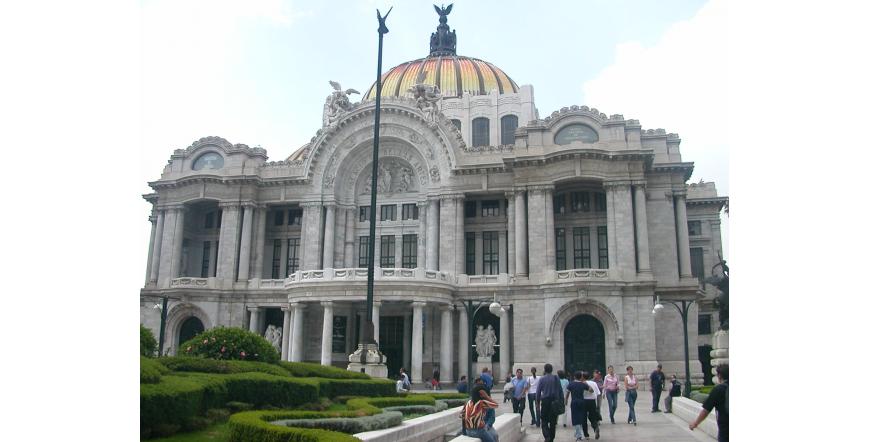
Mexico City is located in the central part of the country. At the beginning of the 14th century the Aztecs built a city on an island in Lake Texcoco, which is now dry. They call the city Tenochtitlan. Two centuries later, the Spanish conquered it and made it the capital of their colony, New Spain. Three hundred years later, Mexico City became the capital of independent Mexico. But the main urban highways have retained some of the complex construction and drainage system of the Aztecs.
Now the city is the capital and largest of the North American country of Mexico. The population of the city itself is about 9 million inhabitants, and the urban agglomeration is 38 million people. Average annual temperatures are between 12 and 16 C. The lowest are in January and February, and the highest in late spring and summer. One of the worst blows to the city was the earthquake in 1985. Despite the many destroyed buildings and casualties, Mexico City managed to recover quickly. The Paseo de la Reforma boulevard was built by order of Maximilian and resembles the Champs-Elysées in Paris. The symbol of Mexico - the Angel of Independence is located here. It is a Victory Column built to commemorate the centennial of the Mexican War of Independence in 1810.
The Basilica of Our Lady of Guadalupe is the holiest place in America for Catholics. It is a cathedral from the time of Spanish rule, which is located on the hill of Tepeyac in the northern part of Mexico. The church was built between 1531 and 1709, and a new one was built in the 1970s. There are 10,000 seats for worshippers.
Ciudad Universitaria is the National Autonomous University of Mexico, one of the largest in the world. Over 270,000 students study there. In 2007, it was included by UNESCO in the list of World Cultural Heritage. Xochimilco is where the last preserved remnants of what the city looked like before the arrival of the Spanish in 1521. Xochimilco is an extensive system of 170 km of canals and flower gardens from the time of the Aztecs. Here, tourists can ride on "trachineras" - brightly colored gondola boats. The site has been declared a World Heritage Site by UNESCO.
Chapultepec Castle is one of Mexico City's favorite places to visit. Built on Chapultepec hill, at one end of the 12 km long Paseo de la Reforma avenue. Its construction began in 1785 by the Spanish Viceroy Bernardo de Calvis. It was finally completed only in 1864, when Maximilian
was crowned Emperor of Mexico. After that, the castle was a military site, a presidential residence and finally in 1939 it was turned into a National Historical Museum. The castle is part of the Chapultepec Park, which occupies an area of 6 square km. Here are also the zoo, several museums, lakes and beautiful corners for walking and relaxing.
There is a place on the outskirts of San Angel, Mexico City, where the artists Frida Kahlo (1907-1954) and Diego Rivera (1886-1957) built their house-studio. Their love is so strong that the two buildings are connected by a bridge located at the level of the roofs. Thus, the lovers could see each other while working and at the same time have separate work spaces. One house was pink - for Rivera, and the other - blue and white - for Kahlo. Rivera's studio was preserved as it was at his death.
One of the most important public buildings for the Mexican nation is the National Palace. It is located on Constitution Square - the second largest square in the world after Red Square in Moscow. The building was built in 1692. It now houses the offices of the Mexican President, the National Archives and the Federal Treasury.
Most of the historical murals of the artist Diego Rivera can be seen here. Above the main entrance is the bell rung by the priest Miguel Hidalgo (1753-1811) when he delivered his speech-call to fight for the independence of Mexico. 40 km north of Mexico City is the area of Teotihuacan, where there was an ancient city of the Aztecs, who called it Teotihuacan (City of the Gods). It reached its heyday in the 3-4th century. In this remarkable area is the third largest pyramid in the world, 65 m high and called the Pyramid of the Sun. It is connected by a street to the smaller Pyramid of the Moon. There are other temples and palaces here - the Palace of the Jaguars, with murals of jaguars with crowns and feathers, and the Palace of Quetzal, where there are columns depicting a half-bird, half-butterfly creature.
The archaeological site "Templo Mayor" is located not far from Constitution Square. The remains of the temple, which is the most important building here, were discovered in 1978. The sanctuary was built in 1390, but it was completed seven times and expanded eleven times. The temple has a pyramidal structure, 60 m high. There were two staircases leading to the top. A number of rituals and sacrifices were performed here, and the mortal remains of heroic warriors and citizens of Tenochtitlan were also cremated.
The house-museum of the Russian revolutionary Lev D. Trotsky is located in Coyoacán, a suburb of Mexico City. He arrived in Mexico in 1936, where he was warmly welcomed by President Lázaro Cárdenas. Trotsky was killed on August 20, 1936 by Ramon Mercader with an ice ax. It is a tragic end to a life filled with many dramatic events.
Vote:
Rating 5 from 1 voted


