

Antwerp, Belgium
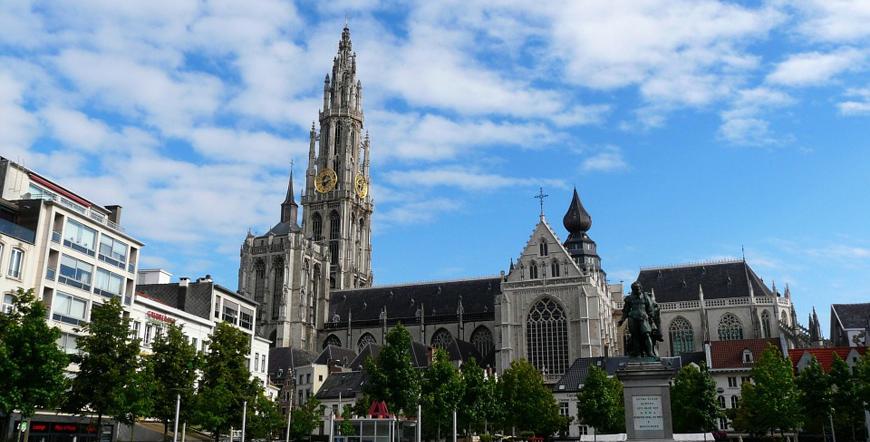
Antwerp is the center of the province of Antwerp in northern Belgium and one of the largest Belgian cities. It is situated on the River Scheldt, close to its confluence with the North Sea, making it one of the country's maritime cities. Antwerp is one of the most culturally and economically developed regions, being important for the country's economy and worth seeing its sights, through which one can experience the masterpieces of Rubens and feel the spirit and enterprise of the time - a transition from the Middle Ages to Modernity.
The name of the town of Antwerp is crowned with an interesting legend. It tells that in the past the river Scheldt was guarded by a mythical giant named Antigonus. He took a toll from anyone wishing to cross its waters, and those who refused parted with one hand. A young man named Brabo was brave enough to outwit the monster - he heroically managed to cut off the giant's arm and throw it into the Scheldt. This is how the name of Antwerp came about - in Dutch werpen means throw.
The history of the Antwerp began to be written in the 4th century, when Frankish settlers settled on the site of today's town. In the 7th century Antwerp converted to Christianity thanks to the efforts of St. Three centuries later it became a border province of the Holy Roman Empire.
Later, the present-day city Antwerp was annexed to the Duchy of Brabant and gradually replaced Bruges as the main economic and commercial center. During the 15th and 16th centuries Antwerp became one of the largest cities on the entire continent and attracted many foreigners due to its high standard and business opportunities. Particularly significant was the presence of Venetian, Portuguese, Spanish and Jewish merchants who controlled much of the local economy.
A stroll through Antwerp's beautiful squares and streets is recommended, starting with the Grand Market Square. In the western part of Antwerp stands the interesting 16th century town hall building. In front of it stands the beautiful statue of Antigonus, the giant who gave the Belgian city its name. Here you can also see female statues symbolizing justice, prudence, the Virgin Mary and others.
Among the architectural and historical sights of Antwerp stands out the Gothic church of St. James. It was built on the place of a hostel for pilgrims to Santiago de Compostela. It contains the tomb of Rubens, which is located in the east chapel of the church.
The construction of this church in Antwerp began in 1491, and by 1656 it was still not completed. As a result of this and the architectural trends in this century, the interior of the church was built in the Baroque style.
The other undisputed architectural landmark among the religious temples in Antwerp is the Cathedral of Our Lady, built for 2 centuries between the 14th and 15th centuries. Its architecture is subordinated to the Gothic style, but still quite a few Baroque elements are distinguished.
Quite interesting is the Farmers tower, which was the first skyscraper on the territory of continental Europe. The old part of the city of Antwerp is also impressive. There you can see the historic medieval castle of Het Steyn, which was built between 1200 and 1225. Today it is the oldest building in Antwerp and houses an interesting shipping museum.
Other main attractions in Antwerp are the zoo, the railway station with its neo-Baroque facades and the Steen, the castle-fortress through which access to the Scheldt was controlled and used as a prison, now functioning as an archaeological museum.
Antwerp is also famous for its school of painters, which included Van Dyck, Jordans and others besides Rubens. Antwerp is also a fashion centre thanks to the Royal Academy of Fine Arts, producing its own brand of liqueur, coffee, sugar, etc.
For centuries Antwerp has been known as the aristocratic city of Belgium. Antwerp is home to the offices of many international corporations, and its port is one of the busiest and most important in Europe.
Vote:
Rating 5 from 1 voted


Weather in Antwerp, Belgium

21.57 °C
Wind: 3.6 m/s
Humidity: 71 %
Pressure: 1003 hpa
Clouds: 0 %
Wind: 3.6 m/s
Humidity: 71 %
Pressure: 1003 hpa
Clouds: 0 %