

Namur, Belgium
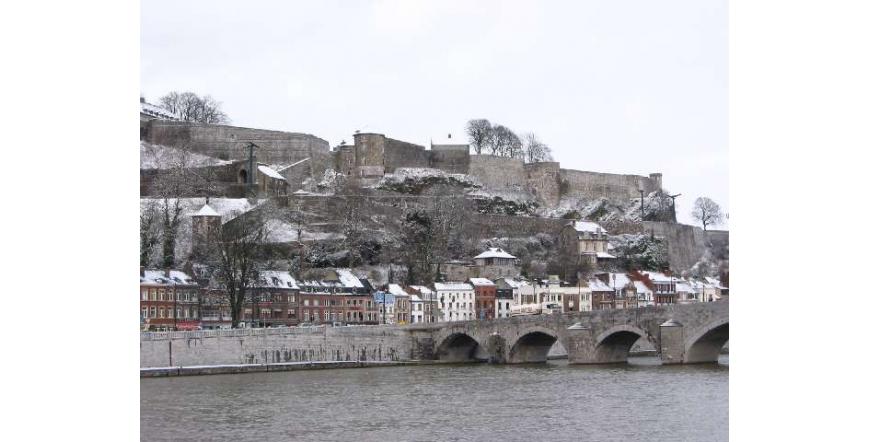
Namur is a city in Belgium, the administrative center of the province of Namur and the capital of Wallonia, one of the three regions of Belgium. The city is situated at the confluence of the River Sambre with the River Meuse, and thus had important strategic importance during the Roman Empire and World War II. Namur was an important industrial and commercial center with a major railway junction.
Namur originated in antiquity, but took its present form in the Middle Ages. Then a massive fortified citadel was built on its lands, towering over the two rivers, the Sambre and the Meuse. It has been rebuilt several times over the centuries and to this day remains an undisputed symbol of Namur. The First and Second World Wars were merciless to Namur and caused great destruction to the city. But it managed to preserve much of its interesting waterfront architecture, narrow cobbled streets and impressive buildings.
Thus, to this day, one of the main and one of the most interesting buildings in Namur is St. Alban's Cathedral. It was built between 1751 and 1767 and has adopted the Italian influence in architecture. The next jewel of Namur is the bell tower of the 1385 St. James Tower on the Place des Armes, which has been declared a World Heritage Site by UNESCO. The Meat Hall, or also known as the historic Kasap House, is also one of Namur's most notable monuments. It is located on the banks of the Sambre and is one of the most important archaeological museums in Wallonia, built between 1588 and 1590 of blue bricks and stones.
Other interesting museums in Namur are the Museum of Ancient Arts, covering the 11th-17th centuries, and the Grosbeek de Croix Museum of Decorative Arts and Crafts, which is housed in a beautiful 18th-century building.
Vote:
Rating 5 from 1 voted


Weather in Namur, Belgium

20.68 °C
Wind: 3.13 m/s
Humidity: 73 %
Pressure: 1004 hpa
Clouds: 100 %
Wind: 3.13 m/s
Humidity: 73 %
Pressure: 1004 hpa
Clouds: 100 %