

Sarajevo, Bosnia and Herzegovina
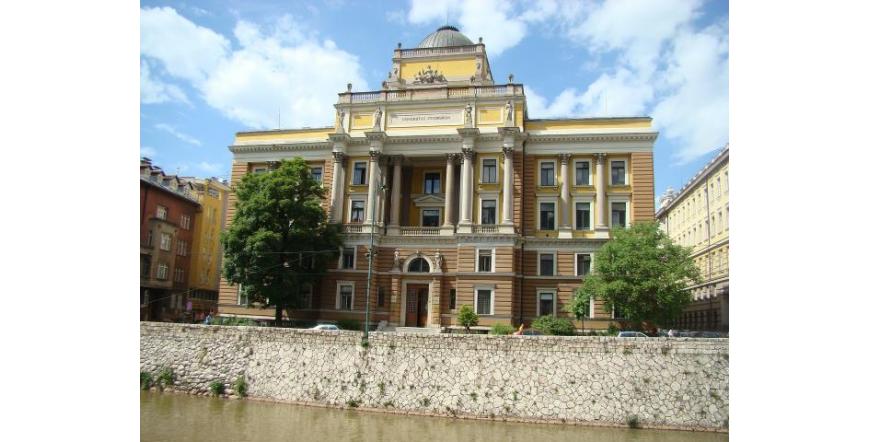
Sarajevo is the capital of Bosnia and Herzegovina and the largest city in the country. It was founded in 1461, when its territory was subject to the Ottoman Empire. Sarajevo has left its mark in world history with the fact that it was in this city that Archduke Franz Ferdinand was assassinated, which led to the outbreak of the First World War. Sarajevo is also famous for hosting the 1984 Winter Olympics.
If we want to trace the birth of Sarajevo and its appearance on the map of the world, we have to go back to the 15th century. It was then, at the beginning of this century, where Roman roads crossed, where people had lived since the Stone Age, that Sarajevo came into being. It is believed that Sarajevo was founded at the time of the invasion of the Ottomans in the Balkans, and Yitzhak Bey Yitzhakovich is named as its founder. The first mosque, a bridge and several other public Ottoman buildings in the city were his work.
Due to its strategic position, Sarajevo fell into the center of craftsmanship and trade. It was they who quickly transformed Sarajevo from a small village into a rich and well-developed city, which a century after its foundation became one of the richest cities in Rumelia. The Ottoman presence in the city was conducive to the construction of many massive buildings and other structures, which today represent excellent examples of Ottoman architecture of the time. The first madrasa, a school attached to a mosque, was also born then, built for Gazi Husrev Bey.
Sarajevo is one of those cities that has been cosmopolitan since its inception. An interesting fact about the city is the settlement of the expelled Spaniard Jews, who built their own synagogue, and Orthodox churches were built, as well as Catholic cathedrals. Thus, like few cities in Europe, Sarajevo became a meeting point and home for all four world religions, cultures and civilizations. The centuries-old coexistence of these different religions and cultures led to the creation of a new culture and civilization that has withstood all the vicissitudes of history.
The Austro-Hungarian rule over Bosnia and Herzegovina brought the city into Western Europe, thus the predominantly oriental city of Sarajevo in the late 19th century acquired the traits of Western European culture, economy and customs. Modern factories were built in Sarajevo, schools were opened on the Western European model, the city was enriched with Western European culture and architecture, and the Zemal Museum was opened, one of the largest cultural institutions in the Balkans.
After the First World War, Sarajevo was gripped by stagnation and lagged behind in its development. After World War II, Sarajevo began to blossom and this revival was due to the development of industry, economy, culture and many other public institutions that made the city the largest city of Bosnia and Herzegovina. The University of Sarajevo, the opera house, many museums and galleries, scientific institutes and others were founded in this period.
The social and political changes in the Balkans after 1991 led to a bloody civil war, which led to the establishment of the independent and sovereign state of Bosnia and Herzegovina, whose capital is the modern city of Sarajevo.
As already noted, Sarajevo is famous for the various religions that are intertwined within it. Apart from the religious temples of each religion, the city also boasts of its museums and architectural landmarks. The rich list of museums includes the Sarajevo Museum, the Ars Aevi Museum of Contemporary Art, the National Museum of Bosnia and Herzegovina, the Museum of Literature and Theatre Art of Bosnia and Herzegovina, and the National Theatre of Bosnia and Herzegovina. Other attractions of the city are the city library, the Art Gallery of Bosnia and Herzegovina and the Bosnian Institute. Among other things, Sarajevo is also a festival city. One of the city's famous festivals is the Sarajevo Film Fest, which was founded in 1995 and has become a major film festival for the Balkans. The Sarajevo Winter Festival, on the other hand, traces its history back to the winter of 1984 and so on. The Sarajevo Jazz Festival is held annually in the first week of November. The top spot is occupied by the biggest of all festivals and that is the "Nights of Baščarsija". This festival is organized annually from the 1st to the 31st of July and includes performances of classical music, rock and roll, folk music, theater, opera, ballet. Sarajevo has found a way to show the different aspects of national culture and this is through various exhibitions of books, films, etc.
Let's walk around Sarajevo some more. Today, the capital of Bosnia and Herzegovina is a vibrant and fast-growing city where East meets West. Sarevo is a city where travel is not just measured in kilometers, but in centuries.
The exquisite Austro-Hungarian streets and buildings blend uniquely into the Ottoman part, called Baszczarsija. Once upon a time, this was the location of Sarajevo's main market. Originally the market enveloped the small space around the fountain, and later the name was passed on to the whole area. Bashcharshija was built on the model of the Arab souks - with wide spaces connected by interweaving small streets. Sarajevo is not just a colorful palette of cultures. The city is also home to many religions. The symbol of Islam is the Ali Pasha Mosque, which was built in 1561 and is one of the most beautiful mosques. The religious house was erected on the order of Ali Pasha himself, the local governor of a sanjak in the Ottoman Empire as a sign of the fulfillment of his last will - Ali Pasha stated in his will that he wanted an imposing mosque to be erected next to his grave. Other impressive mosques are the Tsareva Mosque and the Bey Mosque with two mausoleums and a fountain with hot mineral water.
The Christian religion also has a home in Sarajevo. This is the cathedral, completed in 1889 and modelled on Notre Dame in the French city of Dijon. Among the Orthodox churches, the most impressive is the Old Orthodox Church from 1616, located in Bashcarsjija. Its uniqueness is due to the fact that some elements of Islamic architecture are woven into its architecture. Another jewel of the Christian religion, also a major landmark of Sarajevo, is the Cathedral Church, built in the middle of the 19th century with donations from Dubrovnik, Vienna, Serbia, Trieste, and Sultan Abdulaziz himself. Three synagogues can also be seen in Sarevo.
The Brusa wall is also a famous landmark of Sarajevo. The covered market was built at the will of Rustem Pasha back in 1551.
A tourist tour of the city should not miss the National Museum and the Botanical Garden. The latter is in the very center of Sarajevo and is part of the complex of the National Museum of Bosnia and Herzegovina. It is popular for the fact that more than 2000 species grow there, some of them rare or exotic - Japanese cherry, sequoia, ginkgo. In the center of the garden there is a beautiful fountain surrounded by lush vegetation.
The storytellers of the wars in the former Yugoslavia in the 1990s have already taken a prominent position among the tourist itineraries in the Western Balkans. But the War Tunnel Museum must definitely be acknowledged as the progenitor. This historical landmark of particular importance to Sarajevo. Only it can tell how the inhabitants of Sarajevo were able to get to the airport during the bombing of Sarajevo in the 1990s or how they supplied the Bosnians with food. He was in the yard of a house and passed under territory blockaded by Bosnian Serb militias to link the city to the UN-controlled area. Despite the fact that only 25 m of the then 800 m remain today, the experience is unique.
Sarajevo, the smallest and most inaccessible Balkan capital, is a city with character. The atmosphere is charged with those emotions that only bustling cafes and restaurants, a shimmering river, a mix of Eastern and Austrian architecture, memorable views from the hills and frequent early morning May mists can create.
One thing is undeniable, and that is that the magnet for any visitor to the city is that district of small cobbled streets between shops, workshops, tekkies and mosques and small restaurants, the setting for a series of novels by Mesha Selimovic. Behind this description is the Old Town of Sarajevo, equally attractive to tourists and locals. In the Old Town is a very valuable architectural heritage - the National and University Library. It is housed in a building known as Vijecnica. It was intended to house the building of the municipality of Sarevo. Vijecnica is a curious illustration of what confused ideas of social engineering were swirling in the heads of those who ruled the Austro-Hungarian Empire - Moorish architecture.
Vote:
Rating 5 from 1 voted
More sights in Bosnia and Herzegovina


Weather in Sarajevo, Bosnia and Herzegovina

14.95 °C
Wind: 0.51 m/s
Humidity: 72 %
Pressure: 1017 hpa
Clouds: 0 %
Wind: 0.51 m/s
Humidity: 72 %
Pressure: 1017 hpa
Clouds: 0 %