
Hanging Gardens of Babylon, Iraq
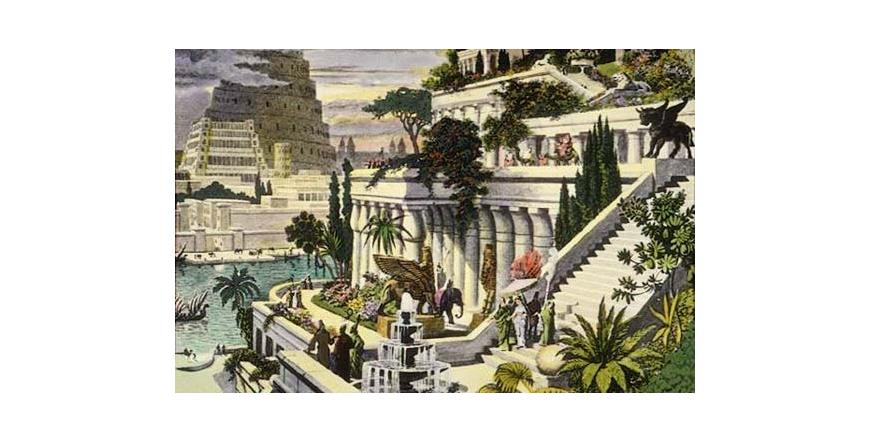
The Hanging Gardens of Babylon are one of the Seven Wonders of the World, but have not been discovered to this day. This wonder of the old world was the pride of the very first city in the history of mankind, Babylon, which was located near today's Al-Hilah in Iraq. The main information about the gardens is drawn from the documents of the Greek historians Strabo and Philo. The Hanging Gardens of Babylon are shrouded in wondrous mystique and romance.
Research suggests that the Hanging Gardens of Babylon were most likely built around 575 BC by King Nebuchadnezzar II, who ruled the city for 43 years, beginning his reign in 605 BC. Another theory says they were built by the Assyrian queen Semiramis during her five-year reign, which began in 810 BC.
The Hanging Gardens of Babylon are terraced and artificially irrigated gardens. Legend has it that Nebuchadnezzar built them so that his wife, the Persian princess Amitis, who hailed from the fertile lands of Mesopotamia, would not be homesick. The maiden was accustomed to the picturesque vegetation of the Mede lands, longed for the trees and fragrant plants, and the dusty Babylon only made her sad. To bring her happiness Nebuchadnezzar II ordered the construction of the Hanging Gardens of Babylon.
Architecturally, the Hanging Gardens of Babylon was a pyramid consisting of four floors - platforms on columns 27.75 m high. According to studies, their lower floor was in the shape of an irregular quadrilateral with sides 42 m by 34 m. To prevent water seeping down, a layer of reeds was stacked on the surface of each platform, two rows of bricks built with gypsum mortar, and lead bricks stacked on top. The top was filled with fertile earth where seeds of various grasses, flowers, shrubs and trees were planted. The gardens of Babylon were called "hanging" deliberately, probably to enhance the glory of this undoubtedly serious technical achievement in relation to the state of the art at that time. For the dry and hot climate of Babylonia, all this greenery and abundant water truly seemed like a miracle. Each terrace of the Hanging Gardens of Babylon constituted a garden in its own right, yet all the terraces formed a whole. Along the outer edge grew creepers and lianas that flowed onto the next terrace, thus uniting all the gardens into a single ensemble of trees, shrubs, hedges, borders, and flower paths.
The irrigation of the terraces of the Hanging Gardens of Babylon was by means of pipes which were placed inside the columns which supported the platforms. The water supplied by the Euphrates River, on which the city of Babylon itself was situated, originated from the uppermost terrace, where it flowed into streams and small waterfalls, irrigating the plants on the lower floors. The uniqueness of the Hanging Gardens of Babylon lay not only in the architectural design, but also in the fact that in these extraordinary gardens bloomed the most amazing and rare species of trees and beautiful flowers. To maintain the Hanging Gardens of Babylon, hundreds of slaves turned the waterwheel day and night with leather vessels to supply them with water from the Euphrates River.