

Jerusalem, Israel
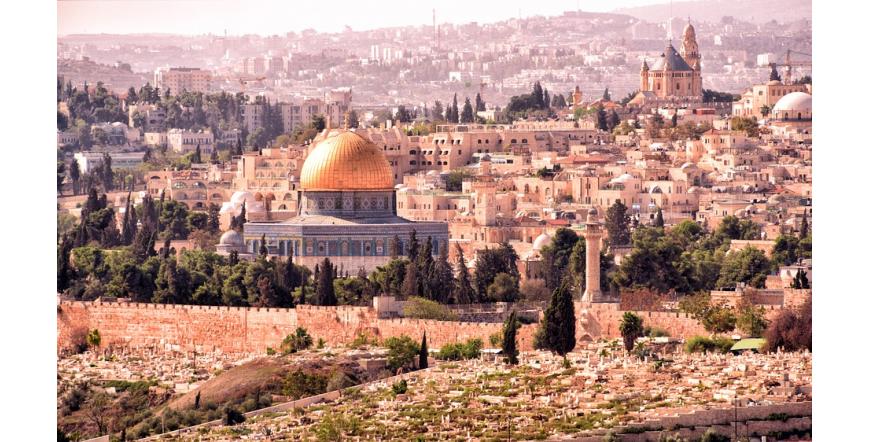
Jerusalem is an ancient city in the Middle East of key importance to the monotheistic religions of Judaism, Christianity and Islam. According to the constitution of the State of Israel, Jerusalem is its unified and indivisible capital. However, most UN member states consider Tel Aviv to be Israel's capital, which is why their embassies are in that city. Jerusalem is located about 60 km east of Tel Aviv and the Mediterranean Sea. Jerusalem is located on the southern part of a plateau that is part of the Judean Mountains and includes the Mount of Olives to the east and Mount Scopius to the northeast of the city center. Jerusalem is a holy place of three religions - Christianity, Judaism and Islam.
History
The "Holy City" as Jerusalem is called recorded its first evidence of existence around the middle of 2000 BC. History tells us that Jerusalem then existed as an integral part of the territory of many ancient and medieval states. Too little is known about the citadel, called Jebus, which David captured in 1000 BC and, after changing its name, made it the centre of the Jewish people. These events mark the beginning of Jerusalem's hieroglyphic history. After David, the government was taken over by his son, Solomon, who built a magnificent temple, walls and palace. Jerusalem lost its political and religious importance after Solomon's death. The city was ruined by the Babylonian ruler Nebuchadnezzar II, who burned Solomon's temple (587 BC), the city was rebuilt by order of King Cyrus the Great.
Tourism
Today, Jerusalem is a city that attracts millions of tourists with both its mystique and historical sights and the holiday conditions it offers. Jerusalem has plenty of restaurants where one can dine deliciously. The nightlife in the city is actively boiling, and people who love romance can fully enjoy it if they take a walk around the city in the evening. The Golden City, as Jerusalem is called in Hebrew, is a unique place where the 1st and 21st centuries mix without losing their identity and space. Here, picturesque old neighborhoods are nestled beneath gleaming office blocks and apartments.
Attractions
Jerusalem is popular around the world not only for its religious significance, but also for its historical sites. The Basilica of Ein Karem, Mount Olivet - the site of the Ascension, the Chapel of the Our Father, the Cave of the Ascension, and the Basilica of the Agony are must-sees.
A walk through the Old City of Jerusalem to visit the Wailing Wall and the Via Dolorosa, Jesus' road to Calvary, would be an amazing experience. Among other things, the Old City is home to the Room of the Last Supper and exciting old Arab markets.
In the New City of Jerusalem is the Mount of Olives, from where you have a magnificent view of the entire city. Another interesting landmark is the Gethsemane Gardens, where the tomb of Mary Magdalene is located. There are no two opinions on the issue of the Holy Sepulchre - during the Easter holidays, many believers flock to the holy site to attend the organised Easter Masses. The Holy Sepulchre is a huge circular temple complex uniting Golgotha, the tomb and the temples of different Christian denominations - Orthodox, Catholic, Armenian, Coptic. The Holy Sepulchre was established in the 4th century by Queen Helena, who organized an expedition to discover the Cross and the tomb. To reach the Holy Sepulchre, one would have to walk the path Jesus Christ walked before being crucified on the Cross. This is the Way of Suffering - the Via Dolorosa. At the centre of the temple complex of the Holy Sepulchre is the Holy Sepulchre itself, and the dome rising above it is considered by Christians to be the centre of the world. In the vestibule is the Church of the Angel, which holds part of the stone from which an angel announced the good news that the Saviour had risen.
In addition to the tomb of God, the Garden of Gethsemane - so called because at that time it was dotted with olive trees and cypresses - holds other treasures. Here are also the Russian monastery of St. Mary Magdalene, the Catholic Church of All Nations (near the place where Judas betrayed the Saviour), and the tomb of St Mary.
The "Tablet of the Anointing" in Jerusalem is another holy site in Israel. It has been identified as the place where the Savior's body was anointed with perfumed oils, wrapped in white cloth, and from there carried to the rock tomb carved nearby by his companion Joseph of Arimathea.
Jerusalem is a city with over 1200 synagogues, 160 churches and over 70 mosques. Undoubtedly, however, the holiest site for Jews is the Temple Mount, also known as the Noble Sanctuary. On this site were erected in ancient times the Temple of Solomon and the Second Temple, of which today only the walls remain. One of these walls is the "Wailing Wall", above which is one of the most sacred places for Muslims - the Dome of the Rock Mosque, from which Mohammed is said to have ascended with his horse. The temple has a fantastic blend of architecture. Pilgrimage to this Jerusalem site for Muslims is equivalent to that to the other two holy sites - Mecca and Medina.
Jerusalem is not only a religious but also a cultural centre. Every visitor to the holy land must visit the National Museum, which houses Qumran manuscripts, archaeological excavations and works of Israeli and European art. In addition, Jerusalem is home to the Yad Vashem Memorial, which was built to commemorate the victims of the Holocaust. It houses the world's richest library on the subject - over 100,000 books and articles.
One of Jerusalem's jewels is the 80-decade-old Jerusalem Museum, which is charged with the daunting task of presenting about the main vein of Israeli history and heritage. The Jerusalem Museum, opened in 1965, is a remarkable example of modern Israeli architecture, housing the world's most complete collection of Judaica, with an emphasis on Ashkenazi and Sephardic culture.
Vote:
Rating 5 from 1 voted
More sights in